How To Measure Your Hair: The Complete Guide (Get It Right Every Time)
Ever tried to measure your hair and ended up with three different numbers? Or maybe you’re tracking hair growth and can’t figure out if you’re actually making progress or just measuring wrong. Trust me, I’ve been there. Learning how to measure your hair accurately is way more important than most people think.
Whether you’re tracking growth, ordering extensions, or planning your next haircut, getting an accurate measurement matters. I spent months frustrated with inconsistent measurements before I figured out the right techniques. Now? I can measure my hair the same way every time and actually trust the numbers.
Here’s the thing—measuring hair isn’t as simple as slapping a ruler against your head and calling it a day. Your hair texture, whether it’s wet or dry, and even how you position the measuring tool all affect your results. But don’t worry, I’m going to walk you through everything you need to know.
Why Accurate Hair Measurement Actually Matters
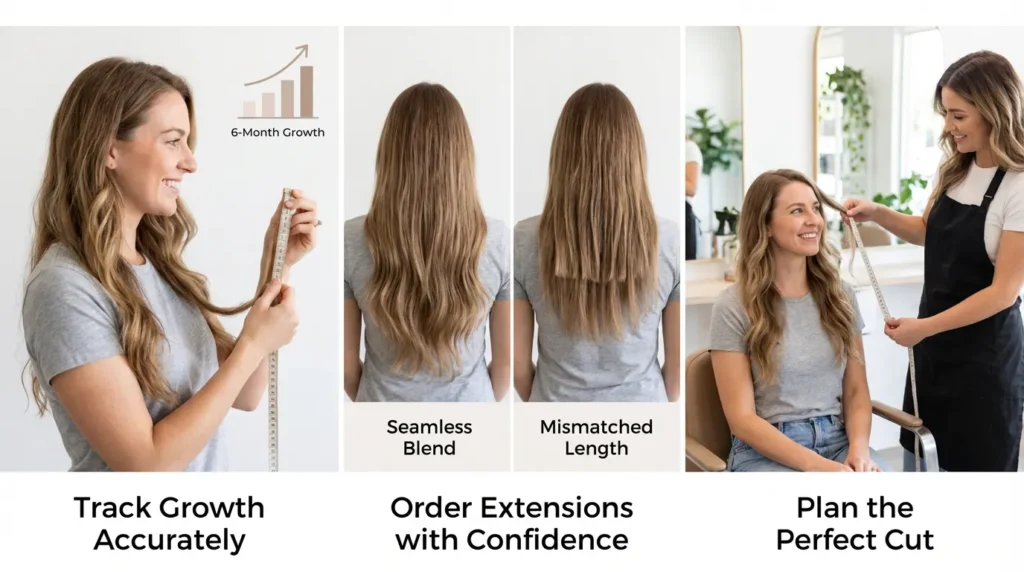
You might be wondering why you should care about precision when measuring your hair. Let me tell you—it makes a huge difference.
Tracking Growth Progress
If you’re trying to grow your hair out, accurate measurements are essential. When you measure consistently and correctly, you can actually see if your hair care routine is working. Random, inconsistent measurements? They’ll just frustrate you and make you think nothing’s helping.
I measure my hair every 6 weeks using the exact same method, and it’s honestly so satisfying to see that progress. Hair grows slowly—we’re talking about half an inch per month on average—so precision matters if you want to track real growth.
Ordering Hair Extensions
This is where measuring your hair wrong can cost you actual money. Order extensions that are too short, and they won’t blend. Too long, and you’ve wasted cash on length you’ll never use. Getting it right the first time saves you from expensive mistakes.
Planning Haircuts and Styles
When you tell your stylist you want to cut off “a few inches,” do you actually know how long your hair is? Accurate measurements help you communicate exactly what you want. No more haircut surprises where you asked for shoulder-length and ended up with a bob.
Understanding Different Hair Lengths (The Visual Guide)

Before we get into how to measure hair properly, let’s talk about what different lengths actually look like. This gives you context for your measurements.
Chin-Length Hair (8-10 inches)
This is your classic bob territory. If you’re measuring 8-10 inches from your scalp, you’re looking at hair that hits right around your jawline when straight. It’s a cute, manageable length that’s been trending forever for a reason.
Shoulder-Length Hair (12-14 inches)
Shoulder-length hair is probably the most common medium length. At 12-14 inches, your hair sits right at your collarbone. This length is super versatile—you can wear it down, put it in a ponytail, or style it in a million different ways.
Mid-Back Length (18-22 inches)
Now we’re getting into longer territory. Mid-back length hair measures 18-22 inches and falls between your shoulder blades and the middle of your back. This is where you start having serious styling options while still being able to manage your hair reasonably well.
Waist-Length Hair (26-30 inches)
At 26-30 inches, your hair reaches your natural waist. This is considered genuinely long hair and requires serious commitment to maintain. But if you can get here and keep it healthy? It’s gorgeous.
Beyond Waist (32+ inches)
Anything past 30 inches is getting into really long territory—tailbone length and beyond. We’re talking years of growth for most people. If this is your goal, accurate hair measurement becomes even more important for tracking that journey.
The Right Tools For Measuring Your Hair
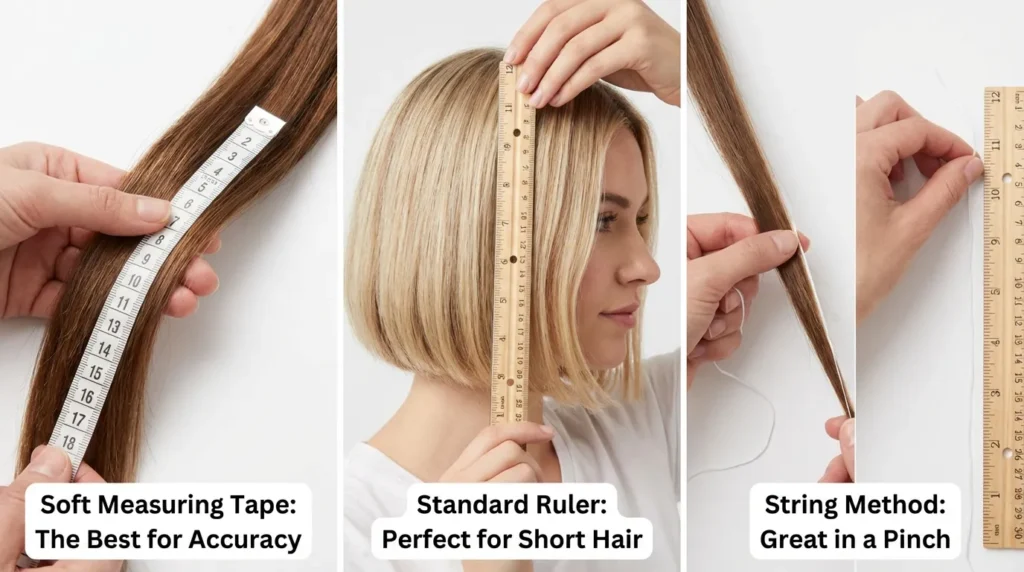
Let me tell you what actually works for measuring hair. You don’t need fancy equipment, but the right tools make a massive difference.
Soft Measuring Tape (The Best Option)
A soft fabric measuring tape—the kind used for sewing—is hands-down the best tool for measuring your hair. It’s flexible, so it follows the curve of your head and hair naturally. It won’t slip, and you can see the measurements clearly.
I got mine from a craft store for like $2, and it’s lasted me years. Get one that has both inches and centimeters marked, and make sure the numbers are easy to read.
Standard Ruler (For Short Hair)
If your hair is shorter than 12 inches, a regular ruler works fine. It’s rigid, which can make it easier to get a straight measurement on shorter lengths. Just make sure it’s at least 12 inches long so you don’t run out of ruler mid-measurement.
String Method (When You’re In A Pinch)
Don’t have a measuring tape? Use string or even dental floss. Measure your hair with the string, mark where it ends, then measure the string against a ruler. It’s not as precise as a proper measuring tape, but it works in a pinch.
I’ve used this method when traveling and forgot my measuring tape. It’s definitely workable, just not ideal for tracking precise growth over time.
How To Measure Your Hair: Step-By-Step Method
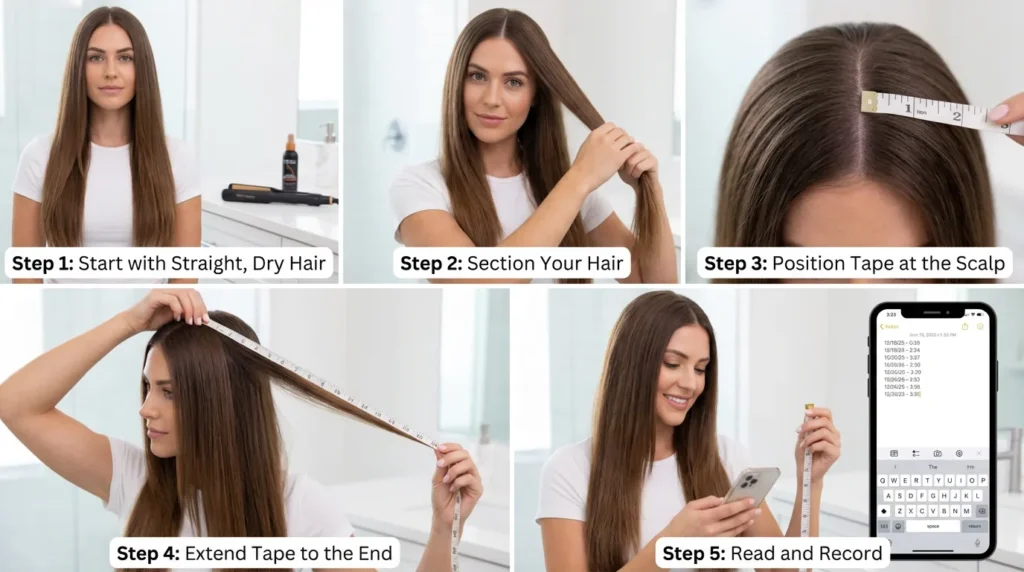
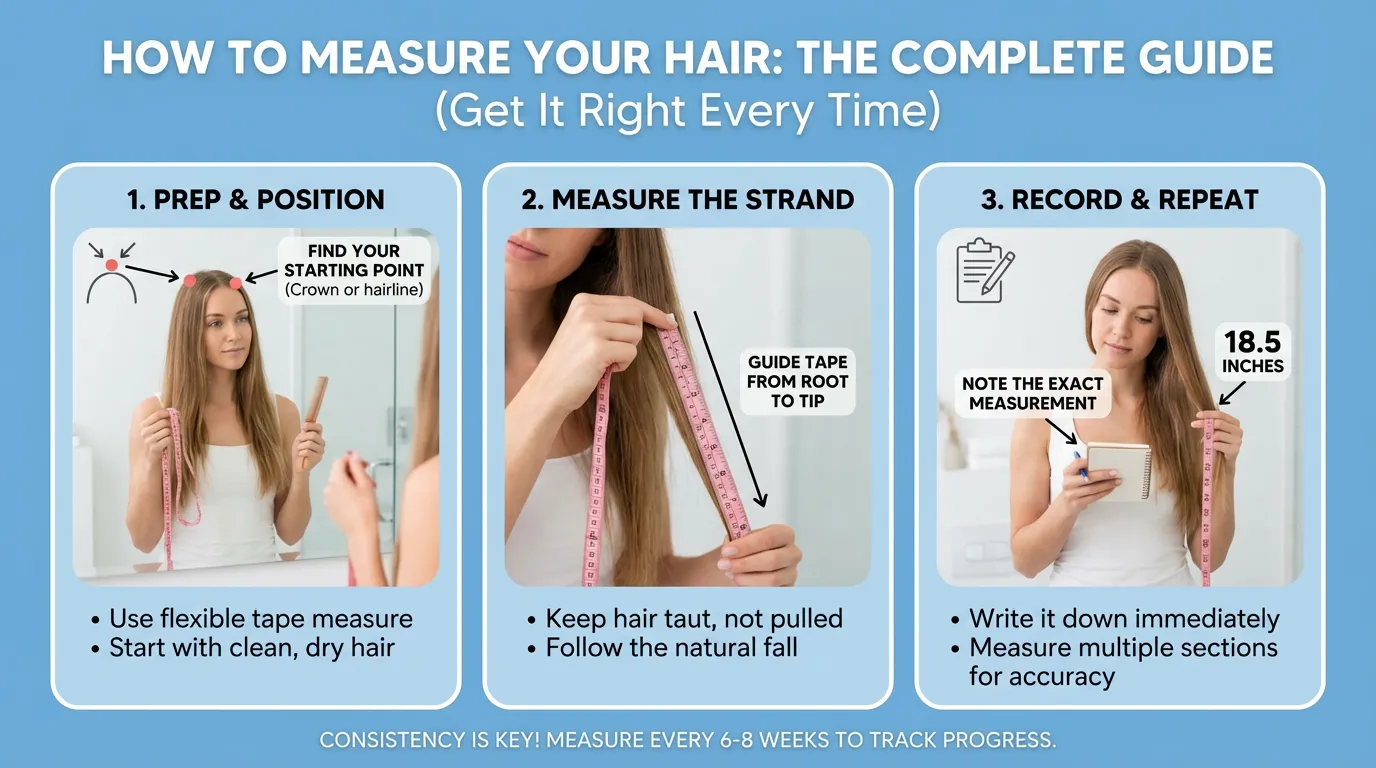
Alright, here’s my exact process for measuring hair accurately every single time.
Step 1: Start With Clean, Dry, Straight Hair
This is crucial. If you have wavy or curly hair, you need to straighten it first for an accurate measurement. I know it’s annoying, but measuring curly hair in its natural state gives you the curl length, not the actual hair strand length.
Wash and completely dry your hair. If you’re straightening, use a heat protectant spray first. Let your hair cool completely after straightening before you measure—warm hair can be slightly longer than cooled hair.
Step 2: Section Your Hair
Don’t just grab a random piece of hair and measure it. Section your hair properly so you’re measuring from a consistent location every time.
I part my hair down the middle and pull it over my shoulders. Then I measure the longest layer in the front section. This gives me a consistent reference point that I can replicate every time.
Some people prefer to measure from the crown of their head straight down the back. That works too—just pick one method and stick with it.
Step 3: Position Your Measuring Tape Correctly
Place the end of your measuring tape (the zero point) directly on your scalp at the root of your hair. Not at your hairline—at your actual scalp where the hair grows from.
This is where a lot of people mess up. If you start measuring from your forehead or an inch away from your scalp, you’re adding length that doesn’t actually exist.
Step 4: Extend The Tape To Your Hair’s End
Pull the measuring tape along the length of your hair, following the strand all the way to the tip. Keep the tape taut but don’t pull your hair tight—you want to measure its natural length, not stretch it.
If you’re measuring over your shoulder, make sure the tape follows the curve of your head and shoulder naturally. Don’t try to create a straight line if your hair naturally curves.
Step 5: Read And Record Your Measurement
Look at where your hair ends on the measuring tape. Read the measurement and write it down immediately with the date.
I keep a notes app on my phone with all my measurements and dates. It’s so satisfying to look back and see the progress over months and years.
How To Measure Different Hair Types
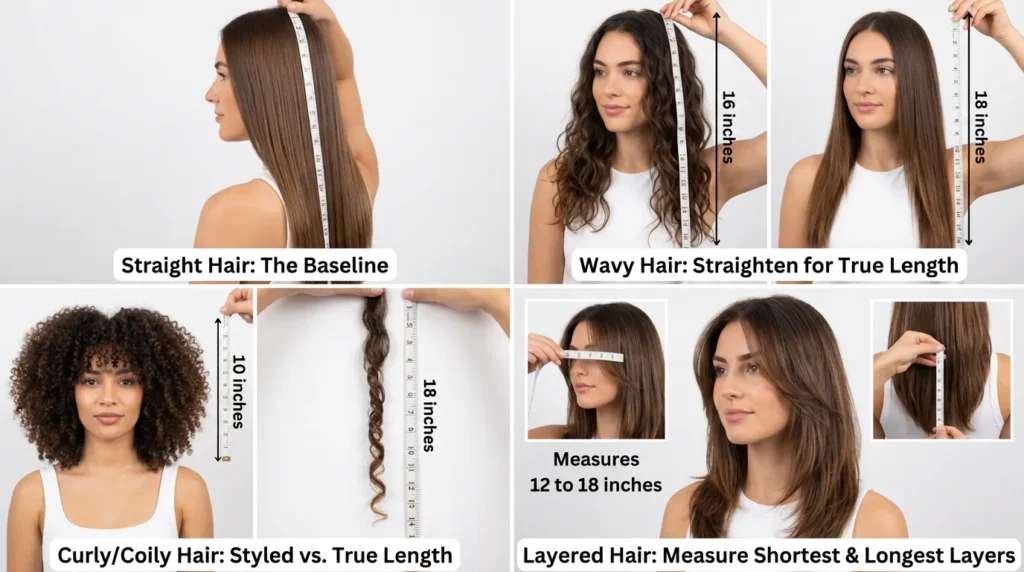
Not all hair measures the same way, and your hair type affects your approach.
Measuring Straight Hair
Straight hair is the easiest to measure accurately. Just follow the steps above, and you’ll get a true length measurement. No special tricks needed here.
Measuring Wavy Hair
Wavy hair needs to be straightened for accurate measurement. Your waves add texture and bounce that shortens the apparent length, but the actual hair strands are longer than they appear.
I have 2B waves, and when I measure my natural hair versus straightened, there’s about a 2-3 inch difference. If you’re tracking growth, always measure in the same state—either always straightened or always natural—for consistency.
Measuring Curly Or Coily Hair
This is where measuring hair gets tricky. Curly and coily hair can have massive shrinkage—your hair might measure 10 inches curly but be 20 inches when straightened.
For curly hair, you have two options:
Option 1: Straighten it and measure the true length. This tells you how long your hair actually is.
Option 2: Measure it in its natural curly state. This tells you how long your hair appears when you wear it curly, which might be more useful for styling purposes.
I recommend doing both and keeping track of both measurements. That way you know your actual length AND your styled length.
Measuring Layered Hair
If you have layers, you need to measure both the shortest and longest layers to get a complete picture of your hair length.
Measure the shortest layer (usually around your face) and the longest layer (usually in the back). This gives you a range—like “12 to 18 inches”—that accurately describes your hair.
Common Mistakes When Measuring Hair (And How To Avoid Them)
Let me save you from the mistakes I made when I first started measuring my hair.
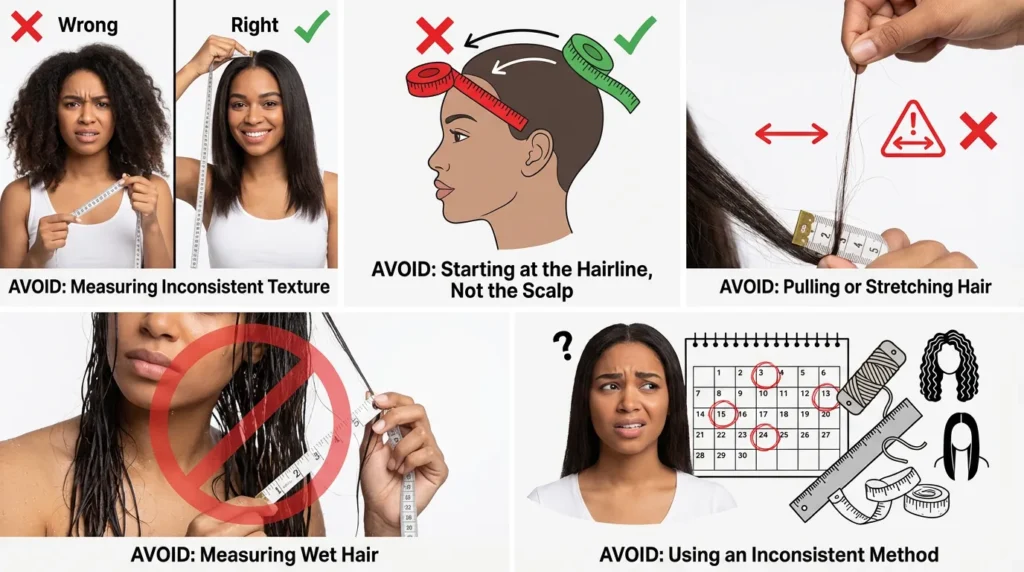
Mistake #1: Not Straightening Curly or Wavy Hair
I did this for months, wondering why my “growth” measurements were so inconsistent. Turns out, measuring wavy hair on different humidity days gives you wildly different results.
Always straighten for consistency, or if you’re measuring natural texture, do it in a controlled environment with similar humidity levels.
Mistake #2: Measuring From The Wrong Starting Point
Starting your measurement from your hairline instead of your scalp can add 1-2 inches of fake length. Your hairline is where your hair meets your forehead—that’s not where hair grows from.
Always start at the actual root on your scalp. Feel for where the hair shaft emerges from your skin—that’s your starting point.
Mistake #3: Pulling Hair Too Tight
When you pull your hair taut while measuring, you’re stretching it beyond its natural length. This gives you inflated measurements that don’t reflect reality.
Keep the measuring tape snug but not tight. Your hair should be hanging naturally, not under tension.
Mistake #4: Measuring Wet Hair
Wet hair can measure longer than dry hair because the water weight pulls it down and stretches it slightly. Then when it dries, it shrinks back up.
Some hair types (especially curly hair) can measure significantly different wet versus dry. Always measure dry hair for consistency.
Mistake #5: Not Using A Consistent Method
This was my biggest problem initially. I’d measure from different spots, sometimes straightened and sometimes not, at different times of day. The inconsistency made it impossible to track actual growth.
Pick ONE method and stick with it every single time. Same starting point, same state (dry/straightened), same measuring tool.
How To Measure Hair For Specific Purposes
Different situations require slightly different hair measuring techniques.
Measuring For Hair Extensions
When you’re ordering hair extensions, accuracy is critical. Here’s how to do it right:
Step 1: Decide where you’ll attach the extensions. For clip-ins, this is usually 2-3 inches below your crown.
Step 2: Measure from that attachment point down to where you want the extensions to end. Don’t measure from your scalp—measure from where the extensions will actually sit.
Step 3: Consider your natural hair’s layering. If you have lots of layers, you might need different lengths of extensions to blend naturally.
I learned this the hard way after ordering 20-inch extensions when I should have gotten 18-inch. They stuck out below my natural hair and looked obviously fake.
Measuring For A Haircut
When you’re planning to cut your hair, measure from your scalp to where you want the cut to end up. This tells you how many inches you’re removing.
For example, if your hair is currently 16 inches and you want shoulder-length (14 inches), you know you’re cutting off 2 inches. This helps you communicate clearly with your stylist.
Measuring For Hair Growth Tracking
For growth tracking, consistency is everything. I measure my hair on the 1st of every month using the exact same method:
- Straightened and completely dry
- Parted down the middle
- Measured from crown to tip of longest front section
- Recorded in my phone notes with the date
This ritual has helped me see that my hair grows about 0.5 inches per month, which is right on track with the average.
Alternative Methods For Measuring Hair
If you don’t have a measuring tape, here are some methods to measure your hair that actually work.
The String Method
Take a piece of string or thread. Place one end at your scalp root and extend it to your hair tip. Mark or cut the string at that point. Then measure the string with a ruler or even against your hand (if you know your hand span measurement).
This method is surprisingly accurate if you’re careful. I’ve used it while traveling when I didn’t have my measuring tape.
The T-Shirt Method
Wear a plain t-shirt and measure from your scalp to where your hair ends against the shirt. Mark that spot with a safety pin or piece of tape. Later, you can measure from the shirt’s shoulder seam to your mark.
This gives you a relative measurement and is great for quick checks between formal measurements.
Using Body Landmarks
Your body provides natural measuring points. On average:
- Chin = 8-10 inches
- Shoulders = 12-14 inches
- Armpit = 16-18 inches
- Mid-back = 20-22 inches
- Waist = 26-30 inches
These aren’t precise, but they’re useful for rough estimates and for communicating with stylists.
How Often Should You Measure Your Hair?
For those of us obsessed with hair growth, how often should we actually measure?
For Growth Tracking: Every 4-6 Weeks
Measuring more frequently than this is pointless and potentially discouraging. Hair grows about 0.5 inches per month on average, so monthly or bi-monthly measurements let you see actual progress.
I measure on the first of every month. It’s become a little ritual I actually look forward to.
For Extension Fitting: Once Before Ordering
You only need to measure once when you’re ready to order extensions. Just make sure you do it right that one time so you don’t waste money.
If your hair length changes significantly (more than 2 inches), re-measure before your next extension purchase.
For Haircut Planning: Right Before Booking
Measure your hair a day or two before your haircut appointment. This gives you fresh, accurate numbers to reference when you’re discussing your cut with your stylist.
Hair can grow a surprising amount between appointments, so don’t rely on measurements from months ago.
Special Considerations For Different Situations
Let’s talk about some specific scenarios for measuring hair.
Measuring Children’s Hair
Kids won’t sit still for precise hair measurement, and that’s okay. Use quick methods like body landmarks (does their hair touch their shoulders? Their waist?) rather than exact measurements.
If you do need precision (like for extensions for a special event), do it when they’re distracted watching TV or right after a bath when they’re calm.
Measuring Hair With Extreme Shrinkage
If you have 4C hair or very tight coils, your shrinkage can be 75% or more. A 20-inch strand might only hang 5 inches in its natural state.
For these hair types, I recommend measuring both stretched length (gently pull a strand straight without heat) and natural length. This gives you the full picture.
Measuring Damaged Or Breaking Hair
If your hair is damaged and breaking, you might get shorter measurements over time even though your hair is technically growing. The breakage is happening faster than the growth.
In this case, focus on improving hair health first. Measure every 2-3 months rather than monthly—you need time for the health improvements to show results.
Creating A Hair Measurement Journal
This might sound obsessive, but trust me—keeping a hair measurement journal is incredibly motivating and useful.
What To Track
In my journal (which is just a note on my phone), I record:
- Date of measurement
- Length in inches
- Hair condition (healthy, dry, damaged, etc.)
- Recent treatments or changes (new product, haircut, color treatment)
- Photos (front and back views)
Why It Helps
Looking back at my measurements from a year ago is amazing. I can see my hair has grown 6 inches, I can correlate growth spurts with specific products or routines, and I have photo evidence of my progress.
It’s especially helpful during plateaus when growth seems to stall. Looking at long-term trends shows me that my hair IS growing, just slowly.
Apps vs. Manual Tracking
There are apps specifically for tracking hair growth, but honestly, a simple notes app works just as well. The key is consistency, not technology.
I tried a fancy hair growth app for a while, but it was overcomplicated. Now I just use Apple Notes with a simple format:
“`
March 1, 2026
Front section: 18 inches
Back section: 19.5 inches
Condition: Healthy, some dryness at ends
Notes: Started using new deep conditioner
[Photo]
“`
Tips For Maintaining Length While Growing
Measuring is one thing, but actually keeping that length is another challenge entirely. Here’s how to protect your hair length.
Get Regular Trims
I know it seems counterintuitive to cut your hair when you’re trying to grow it, but regular trims (every 10-12 weeks) prevent split ends from traveling up the hair shaft.
A split end that travels 3 inches up your hair can break off, losing you months of growth. A preventive quarter-inch trim saves you from losing those 3 inches.
Protect Your Ends
The ends of your hair are the oldest part and the most fragile. Keep them moisturized with[hair oil or leave-in conditioner.
I apply a tiny bit of argan oil to my ends every night before bed. It’s made a huge difference in preventing breakage.
Use Protective Hairstyles
When you’re sleeping, exercising, or doing activities that might damage your hair, put it in a protective style. Loose braids, buns, or even just a low ponytail prevent tangles and friction.
I sleep with my hair in a very loose braid on a silk pillowcase. This combo has seriously reduced my morning tangles and breakage.
Minimize Heat Styling
Every time you use heat tools on your hair, you’re causing some level of damage. This damage accumulates and can slow growth or cause breakage.
I limit heat styling to once or twice a week max, and I always use a heat protectant. On other days, I embrace air-drying or heatless curl methods.
Frequently Asked Questions About Measuring Hair
Q: Should I measure my hair wet or dry?
Always measure dry hair for accuracy. Wet hair stretches and appears longer than it actually is. Once it dries, it shrinks back to its true length, which can make you think you’ve lost length when you haven’t.
Q: How do I measure hair that’s different lengths all over?
Measure both your shortest layer (usually near your face) and your longest layer (usually in back) separately. This gives you a complete picture—for example, “12 inches in front, 16 inches in back.”
Q: Can hair growth speed up or slow down?
Yes. Your hair growth rate can change based on health, nutrition, stress, hormones, and season. Many people notice faster growth in summer and slower growth in winter. Track your measurements over time to see your personal patterns.
Q: Why does my hair seem to stop growing at a certain length?
Your hair isn’t actually stopping—it’s breaking at the same rate it’s growing. This creates a “terminal length” where your hair seems stuck. Focus on reducing breakage through better care, and you’ll surpass this plateau.
Q: Is it normal for hair to grow at different rates on different parts of my head?
Absolutely. The hair on top of your head often grows faster than the hair at the nape of your neck. This is completely normal and is why hair can develop natural layers even without cutting.
Q: How accurate do my measurements need to be?
For growth tracking, being accurate within a quarter-inch is plenty. For extensions or haircuts, try to be accurate within an eighth of an inch. Perfect precision isn’t necessary—consistency in your method matters more.
Q: Should I measure from the same spot every time?
Yes! Pick one section (I use the front-center section) and always measure from that exact spot. This eliminates variability and gives you true growth tracking over time.
My Final Thoughts On Hair Measurement
Learning how to measure your hair correctly might seem like a small thing, but it’s actually transformed how I approach hair care. Instead of guessing whether my hair is growing or if products are working, I have actual data.
The key takeaways? Use a soft measuring tape, start from your scalp (not your hairline), keep your hair straight and dry, and measure from the same spot every time. Do this consistently, and you’ll have reliable measurements you can actually trust.
Don’t stress too much about perfection, though. Hair measurement isn’t rocket science—it just requires a bit of attention to detail and consistency. Even if you’re off by a quarter-inch here or there, you’ll still see the overall growth trend over time.
Now grab that measuring tape and see where you’re starting from. In 6 months or a year, you’ll be so glad you documented your progress!
Have you been tracking your hair growth? What’s your current length and what’s your goal? Drop your measurements in the comments—let’s motivate each other!