
How to Care for Black Bat Flower: The Ultimate Growing Guide That Actually Works
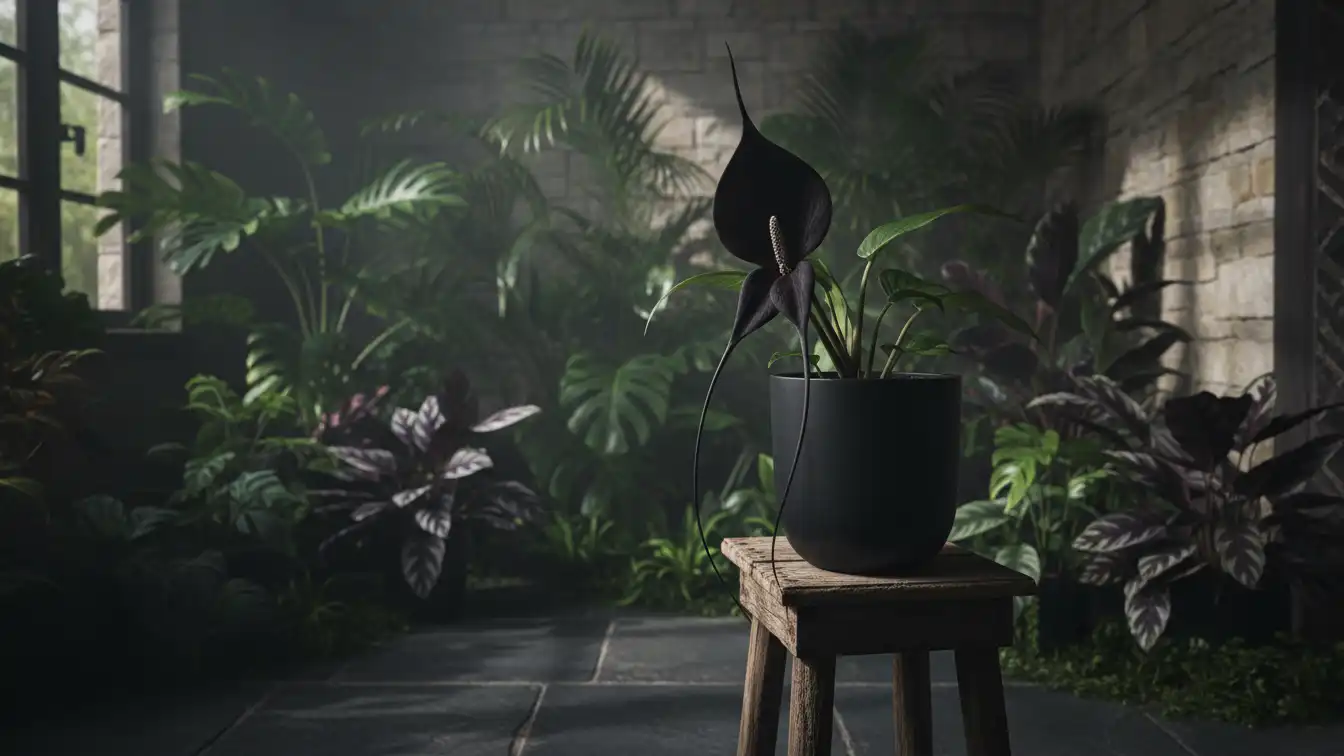
If you’ve stumbled across the mesmerizing Black Bat Flower and wondered whether you could actually keep this gothic beauty alive, you’re in the right place. Trust me, I get it—this plant looks like it requires a degree in horticulture and a prayer to the plant gods.
But here’s the truth: learning how to care for black bat flower isn’t as scary as those dramatic blooms might suggest.
With the right approach (and a little patience), you can absolutely master black bat flower care and watch those eerie, wing-shaped blooms emerge season after season.
Let me walk you through everything you need to know, from the basics to the pro-level tricks that’ll make your neighbors green with envy.
What Makes the Black Bat Flower So Special?
Before we dive into how to care for black bat flower plants, let’s appreciate what makes this specimen so extraordinary.
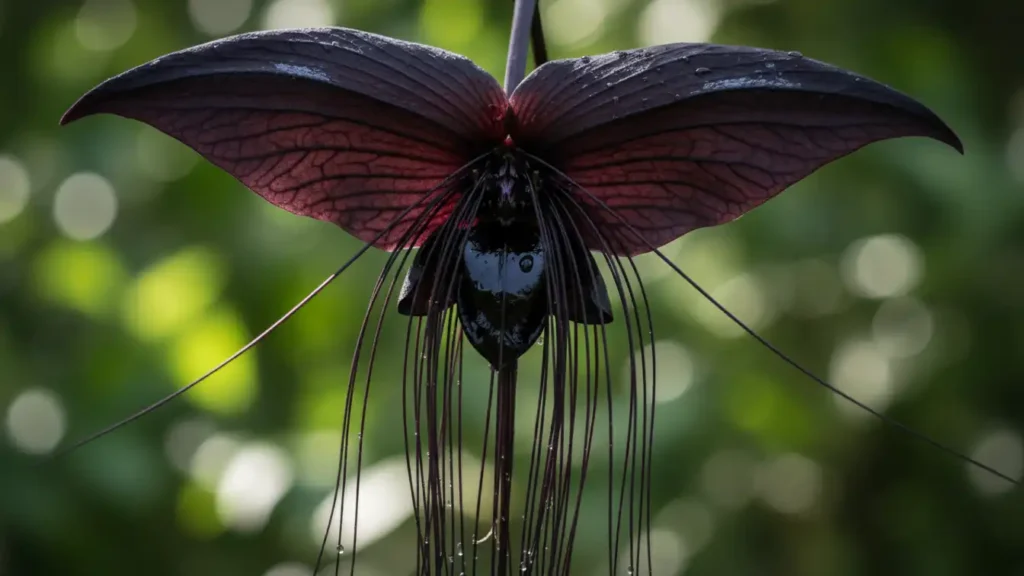
The Black Bat Flower (Tacca chantrieri) isn’t just unusual—it’s downright theatrical. Native to the steamy rainforests of Southeast Asia, including Thailand, Malaysia, and southern China, this member of the yam family (Dioscoreaceae) produces flowers that look like they were designed for a Tim Burton film.
Each bloom can reach up to 12 inches across, with deep blackish-purple petals (technically bracts) that resemble bat wings in flight. But the real showstopper? Those long, thread-like whiskers—called bracteoles—that can dangle down over 2 feet, giving the flower an otherworldly, almost sinister appearance.
Other common names for this beauty include:
- Devil Flower
- Cat’s Whiskers
- Tiger Beard
- Bat Head Lily
- Voodoo Flower
The plant itself grows from fleshy rhizomes and can reach 24-36 inches tall with glossy, lance-shaped leaves that create a lush tropical backdrop for those dramatic blooms.
Fun fact: There’s also a White Bat Flower (Tacca integrifolia) that’s even larger but notoriously fussier to grow. The white variety can reach 36-48 inches tall but flowers less frequently than its black counterpart.
Is the Black Bat Flower Right for You?

Let’s be real for a second. Learning how to care for black bat flower successfully requires honest self-assessment.
This isn’t a “set it and forget it” houseplant like a pothos or snake plant. The Black Bat Flower is what I call a “relationship plant”—it needs consistent attention and specific conditions to thrive.
If you love dramatic plants in your sleeping space, pairing your Black Bat Flower with other bedroom plants that improve air health and wellness can turn your room into a lush little retreat.
You’ll love growing this plant if you:
- Enjoy unique, conversation-starting specimens
- Can maintain consistent humidity levels
- Have patience (blooms can take 6-12 months to appear)
- Love the thrill of successfully growing “difficult” plants
- Have bright, indirect light available
- Are willing to check on your plant regularly
Maybe choose something else if you:
- Travel frequently without plant-sitters
- Have very dry indoor air with no way to humidify
- Only have sunny, south-facing windows
- Prefer low-maintenance plants
- Get discouraged easily
If you’re still reading, fantastic! You’ve got the right mindset for black bat flower care success.
Black Bat Flower Care Requirements at a Glance
Here’s your quick-reference guide for how to care for black bat flower:
| Care Aspect | Requirement |
|---|---|
| Light | Bright, indirect light; dappled shade; no direct sun |
| Water | Keep evenly moist; top inch can dry slightly |
| Humidity | High (60-80%); minimum 50% |
| Temperature | 70-85°F (21-29°C); never below 55°F (13°C) |
| Soil | Rich, well-draining, organic mix |
| Fertilizer | Every 2-4 weeks during growing season |
| USDA Zones | 9b-11 (indoors elsewhere) |
| Blooming | Late spring through fall; up to 8 times per season |
| Toxicity | Mildly toxic to pets; contains calcium oxalate |
Now let’s break down each element of proper black bat flower care in detail.
The 7 Essential Elements of Black Bat Flower Care
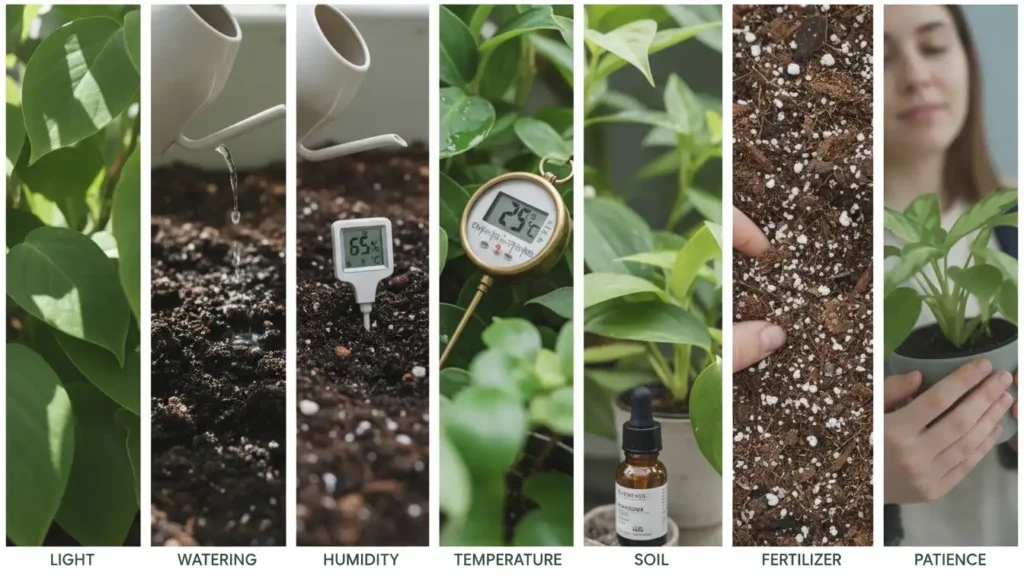
1. Light: Finding That Perfect Jungle Floor Glow
If there’s one thing that’ll make or break your black bat flower care routine, it’s getting the lighting right.
Remember, in its native habitat, this plant grows on the rainforest floor beneath a thick canopy. It’s evolved to thrive in filtered, dappled light—never harsh, direct sun.
What “bright, indirect light” actually means:
- Near an east-facing window (ideal for morning gentleness)
- A few feet back from a south or west-facing window
- Near a north-facing window with additional ambient light
- Under a shade tree outdoors (in warm climates)
Signs your lighting is wrong:
- Too much light: Leaves develop brown, crispy edges or bleached-looking spots; leaves may curl inward
- Too little light: No blooms despite proper care elsewhere; leggy, stretched growth; pale, yellowish leaves
Pro tip: I’ve found that sheer curtains work beautifully for filtering strong light. You want the plant to cast a soft, fuzzy shadow—not a sharp one—which indicates perfect brightness without intensity.
For indoor growing, placing your black bat flower near an eastern window has given me the best results. The gentle morning sun filtered through leaves outside creates that perfect dappled effect.
2. Watering: The Goldilocks Challenge
Here’s where many people struggle with how to care for black bat flower: the watering dance.
This plant wants consistently moist soil—not wet, not dry, but that perfect “just right” sweet spot. Think of a wrung-out sponge rather than a soaking-wet one.
The proper watering technique:
- Check the top inch of soil with your finger
- If it feels dry to the touch, it’s time to water
- Water thoroughly until excess drains from the bottom
- Empty the drainage saucer after 15 minutes (no standing water!)
- Wait until the top inch dries slightly before watering again
Seasonal adjustments:
- Spring through summer (active growth): Water more frequently, possibly every 3-5 days
- Fall and winter (dormancy): Reduce watering significantly, possibly once every 7-10 days, but never let soil completely dry out
Common watering mistakes in black bat flower care:
❌ Overwatering → Leads to root rot (the #1 killer)
- Signs: Mushy, yellowing leaves; foul-smelling soil; black, slimy roots
❌ Underwatering → Causes stress and prevents blooming
- Signs: Crispy leaf tips; leaves dropping prematurely; wilting despite moist air
❌ Inconsistent watering → Confuses the plant and stunts growth
- Signs: Erratic growth; leaf tip browning; reduced flowering
Water quality matters too: Black bat flowers prefer slightly acidic conditions, so if you have hard tap water, consider using filtered water or letting tap water sit out for 24 hours before using it.
The saucer method: Some growers keep their pots sitting in saucers with pebbles and a bit of water (pot bottom not touching water). This provides both humidity and a visual reminder of the plant’s moisture needs—when the saucer dries out, check if watering is needed.
3. Humidity: Creating Your Indoor Rainforest
If you want to truly master how to care for black bat flower, you absolutely must address humidity. This is non-negotiable.
These plants evolved in tropical rainforests where humidity hovers between 60-80%. Most homes sit around 30-40% humidity, especially in winter with heating systems running.
The humidity hierarchy (from least to most effective):
Basic Level: Grouping & Misting
- Group your bat flower with other tropical plants to create a microclimate
- Mist around (not directly on) the plant daily
- Effectiveness: 3/10 (temporary, requires daily commitment)
Intermediate Level: Pebble Trays
- Fill a wide, shallow tray with pebbles
- Add water until it’s just below the top of the pebbles
- Place your pot on top (bottom not touching water)
- As water evaporates, humidity rises around the plant
- Effectiveness: 6/10 (helps but limited range)
Advanced Level: Humidifiers
- Use a cool-mist humidifier near your plant
- Run it especially during heating season
- Aim for 60-70% relative humidity
- Effectiveness: 9/10 (consistent, measurable results)
Expert Level: Enclosed Growing
- Grow in a terrarium (for smaller specimens)
- Use a grow tent with humidity control
- Create a dedicated “humidity corner” with multiple plants and a humidifier
- Effectiveness: 10/10 (perfect control but requires space)
How to measure humidity: Get a simple hygrometer (they’re under $10 on Amazon). Place it near your plant and check it regularly. If it consistently reads below 50%, your black bat flower will struggle.
Signs of low humidity:
- Crispy, brown leaf edges and tips
- Leaves curling inward
- Stunted growth
- No blooming despite other conditions being met
- Overall droopy, sad appearance
My personal setup: I run a humidifier during the day near my tropical plant corner, where my Black Bat Flower sits with orchids and ferns. This creates a consistently humid microclimate that keeps everyone happy.
4. Temperature: Keeping Things Tropical Year-Round
Black bat flower care requires consistent warmth—these plants are seriously cold-sensitive.
Ideal temperature range:
- Summer: 77-85°F (25-29°C)
- Winter: 65-70°F (18-21°C)
- Absolute minimum: Never below 55°F (13°C)
Temperatures below 55°F can cause permanent damage or death. Below 40°F is basically a death sentence for this tropical beauty.
Temperature considerations for black bat flower care:
✓ Keep away from:
- Air conditioning vents (cold drafts)
- Heating vents (hot, dry air)
- Drafty windows in winter
- Exterior doors that open frequently
- Unheated sunrooms or garages
✓ Best locations:
- Interior rooms with stable temps
- Bathrooms with good light (bonus humidity!)
- Climate-controlled sunrooms
- Near other heat-loving plants
Seasonal temperature tips:
- Summer outdoor placement: Can go outside in zones 9-11, but watch nighttime temps
- Winter protection: Move away from windows; consider a plant heating mat if your home gets chilly
- Transitioning seasons: When bringing plants inside for fall, acclimate gradually over 1-2 weeks
The “microclimate check”: Place your hand where the plant sits at different times of day. Does it feel drafty? Unusually hot or cold? Your hand is a great temperature sensor for identifying problem spots.
5. Soil: Building the Perfect Foundation
Getting the soil right is crucial for successful black bat flower care. These plants need a mix that drains quickly yet retains some moisture—basically, the Goldilocks of potting media.
What NOT to use:
- ❌ Standard potting soil alone (too heavy, holds too much water)
- ❌ Garden soil or “native” soil (way too dense)
- ❌ Cactus/succulent mix (drains too quickly)
- ❌ Anything without drainage amendments
Perfect Black Bat Flower Soil Recipes:
Recipe #1: The Standard Mix
- 50% peat moss or coco coir
- 30% perlite
- 20% pine bark fines
- Optional: handful of worm castings for nutrition
Recipe #2: The Orchid-Inspired Mix
- 40% peat moss
- 40% orchid bark mix
- 10% perlite
- 10% sand or fine vermiculite
Recipe #3: The Ready-Made Solution
- African violet potting mix (straight from the bag!)
- Add a handful of perlite per quart of mix
- This is my go-to for simplicity
Recipe #4: The Premium Blend
- 50% pine bark (small pieces)
- 40% peat moss
- 10% coarse sand
- Sprinkle of charcoal for freshness
Why these ingredients matter:
- Peat moss/Coco coir: Retains moisture while staying light
- Perlite: Creates air pockets, prevents compaction
- Pine bark: Mimics natural forest floor material
- Sand: Improves drainage without being too fast
- Vermiculite: Holds moisture and nutrients
Soil pH: Black bat flowers prefer slightly acidic conditions (pH 6.1-7.5). Most peat-based mixes fall naturally into this range.
Repotting tips for black bat flower care:
- Repot every spring for best results (fresh nutrients!)
- Use a wide, shallow pot rather than deep (rhizomes spread horizontally)
- Don’t pot up too dramatically—go up just one size
- These plants bloom better when slightly pot-bound (but not root-bound)
6. Fertilizing: Feeding Your Dramatic Beauty
Proper fertilization is a key component of comprehensive black bat flower care, especially during the growing and blooming seasons.
Fertilizer schedule:
- Spring through early fall: Every 2 weeks
- Late fall through winter: Stop feeding (dormancy period)
Best fertilizer types:
Option 1: Balanced Water-Soluble Fertilizer
- Use 10-20-10 or 20-20-20 ratio
- Dilute to HALF strength
- Apply when watering every other week
Option 2: Orchid Fertilizer
- These work brilliantly for bat flowers
- They’re formulated for similar growing conditions
- Use as directed, but consider diluting to 3/4 strength
Option 3: Slow-Release Granules
- Apply once at the start of growing season
- Less fuss, but less control
- Use formulas designed for flowering tropical plants
Why dilute? Black bat flowers have relatively sensitive roots. Strong fertilizer can burn them, causing more harm than good. It’s always better to under-feed slightly than over-feed.
Signs of fertilizer issues:
Over-fertilized:
- White crusty buildup on soil surface
- Brown, crispy leaf tips
- Salt accumulation at pot rim
- Stunted growth (counterintuitively)
Under-fertilized:
- Pale, yellowing leaves (not just old ones)
- Weak, leggy growth
- No blooms despite perfect other conditions
- Very slow growth
Pro fertilizer tip: Every 2-3 months, flush your pot with plain water (pour water through until it drains out the bottom several times). This rinses away salt buildup from fertilizer and prevents root burn.
7. Patience and Observation: The Secret Ingredient
Here’s something most guides on how to care for black bat flower don’t tell you: patience is genuinely your most important tool.
This plant operates on its own timeline. Even with perfect care, you might wait 6-12 months (or longer!) for your first bloom. Young plants grown from rhizomes typically take 2-3 years to reach flowering maturity.
What to expect in Year 1:
- Months 1-3: Establishment phase; focus on root development
- Months 4-6: New leaf growth; plant gaining size
- Months 7-9: Continued vegetative growth
- Months 10-12: Possible first blooms (if plant is mature enough) or continued vegetative growth
The blooming reality: Once mature and happy, your Black Bat Flower can bloom up to 8 times in a single growing season. Each bloom lasts several weeks. But getting to that “happy place” requires mastering all aspects of black bat flower care.
Observation is your superpower: Spend 5 minutes every few days really looking at your plant. Check for:
- New growth emerging from the center
- Leaf color changes
- Soil moisture levels
- Signs of pests or disease
- Overall “vibe” (yes, plants have vibes!)
The more you observe, the better you’ll understand what your specific plant needs in your specific environment.
Seasonal Black Bat Flower Care: Your Month-by-Month Guide
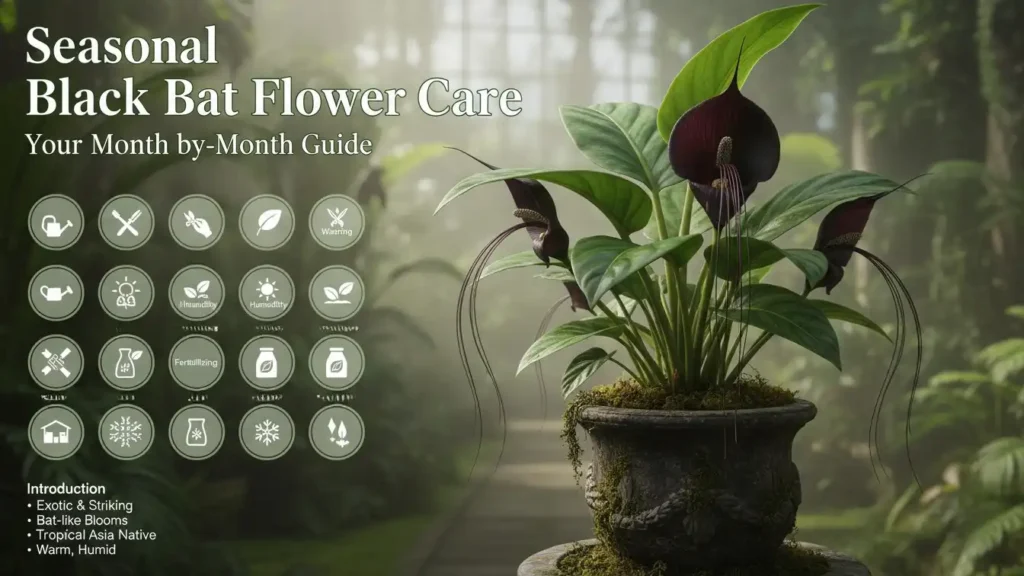
Understanding seasonal changes is essential for year-round black bat flower care success.
Spring (March-May)
The Wake-Up Season
This is when your Black Bat Flower exits dormancy and gears up for growth.
✓ Begin regular fertilizing (every 2 weeks) ✓ Increase watering frequency as days warm ✓ Repot if needed (early spring is ideal) ✓ Divide rhizomes for propagation if desired ✓ Move to brighter location if it was in dimmer winter spot ✓ Resume full humidity regimen
What to expect: New leaves emerging from rhizomes; increased growth rate; possibly early blooms by late spring
Summer (June-August)
The Glory Season
Peak growing and blooming time for black bat flower care efforts to pay off.
✓ Maintain consistent moisture (may need daily watering in heat) ✓ Keep fertilizing every 2 weeks ✓ Monitor humidity closely (AC can dry air) ✓ Ensure shading from hot afternoon sun ✓ Check for flower stalks emerging ✓ Can move outdoors to shaded patio (zones 9-11)
What to expect: Multiple blooms appearing; vigorous leaf growth; plant at its absolute best
Fall (September-November)
The Transition Season
The plant begins preparing for its rest period.
✓ Gradually reduce watering frequency ✓ Stop fertilizing by late October
✓ Bring outdoor plants inside before temps drop below 55°F ✓ Late-season blooms may still appear ✓ Watch for dormancy signs (slowed growth)
What to expect: Blooming tapers off; growth slows; plant enters semi-dormant state
Winter (December-February)
The Rest Season
Black bat flower care shifts to maintenance mode during dormancy.
✓ Water sparingly—let top 1-2 inches dry between waterings ✓ No fertilizer at all ✓ Maintain warmth (never below 55°F) ✓ Keep humidity moderate (50%+ still important) ✓ Provide as much indirect light as possible ✓ Don’t panic if it loses a leaf or two
What to expect: Minimal to no growth; plant “resting”; in very warm climates, may stay semi-active
Important dormancy note: In consistently warm, humid climates (like Florida or Hawaii), Black Bat Flowers may not experience full dormancy. They’ll remain evergreen and might even produce occasional blooms. Adjust your care accordingly based on your climate and what your plant is actually doing.
Common Black Bat Flower Problems (And How to Fix Them)
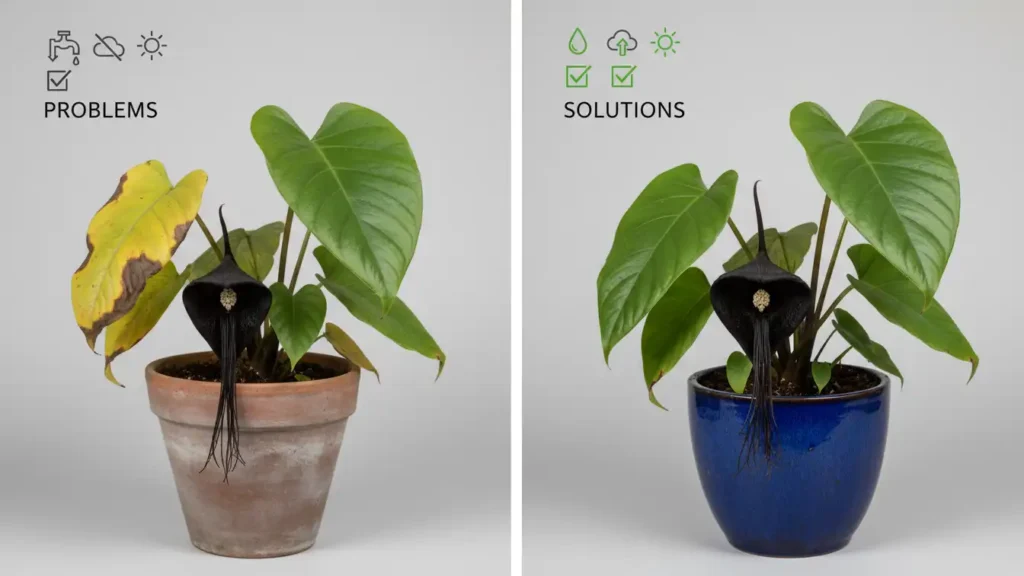
Even with perfect black bat flower care, issues can arise. Here’s your troubleshooting guide.
Yellow Leaves
Most likely causes:
- Underwatering (most common)
- Fix: Water more consistently; check soil daily
- Signs: Dry soil, crispy leaf edges too
- Overwatering / Root rot
- Fix: Reduce watering; improve drainage; check roots for rot
- Signs: Mushy leaves, foul soil smell, constant wetness
- Nutrient deficiency
- Fix: Resume fertilizing schedule if you’ve been skipping it
- Signs: Overall pale appearance, slow growth
- Natural aging
- Fix: None needed! Old leaves naturally yellow and drop
- Signs: Only oldest, lower leaves affected
Brown Spots on Leaves
Most likely causes:
- Sunburn
- Appearance: Dry, crispy brown patches on leaves facing light
- Fix: Move to less bright location or add sheer curtain
- Fungal infection
- Appearance: Wet-looking dark spots, possibly with yellow halos
- Fix: Improve air circulation; reduce humidity slightly; remove affected leaves; apply copper fungicide if severe
- Overwatering
- Appearance: Brown, mushy spots; general droopiness
- Fix: Reduce watering; ensure proper drainage
Leaves Dropping or Falling Over
Most likely causes:
- Temperature stress
- Cold drafts or temps below 55°F
- Fix: Move to warmer, draft-free location
- Watering issues
- Either too much or too little
- Fix: Adjust watering; check soil moisture daily
- Low humidity
- Leaves dropping to conserve moisture
- Fix: Increase humidity immediately
- Root problems
- Root rot or severe root-bound condition
- Fix: Unpot and inspect roots; trim damaged parts; repot in fresh soil
No Blooms (Despite Good Care)
Most likely causes:
- Plant is too young
- Needs 2-3 years to mature from rhizome
- Fix: Patience! Keep providing excellent care
- Insufficient light
- Won’t bloom in too-dim conditions
- Fix: Move to brighter (but still indirect) location
- Wrong temperature
- Needs consistent warmth to bloom
- Fix: Ensure temps stay 70-85°F during growing season
- Not enough leaves
- Plant needs at least 2-3 mature leaves before blooming
- Fix: Focus on vegetative growth first
- Dormancy interruption
- Needs winter rest period to bloom properly
- Fix: Allow proper dormancy (reduce water, stop fertilizer in winter)
Wilting Despite Moist Soil
Most likely cause: Root rot
This is the #1 killer in black bat flower care.
How to save a plant with root rot:
- Remove plant from pot immediately
- Shake off all old soil
- Inspect roots—healthy roots are firm and white/tan
- Cut away any black, mushy, or smelly roots with sterilized scissors
- Let plant air-dry for a few hours
- Repot in completely fresh, well-draining soil
- Water lightly and keep in warm, bright spot
- Reduce watering frequency going forward
- Improve pot drainage (more holes, better soil)
Prevention: This is why proper soil and watering are so crucial in black bat flower care!
Pests
Black bat flowers are generally pest-resistant, but problems can occur:
Aphids
- Small green/black bugs on new growth
- Fix: Spray off with water; use insecticidal soap
Spider mites
- Tiny dots on undersides of leaves; fine webbing
- Fix: Increase humidity (they hate it); spray with neem oil
Fungus gnats
- Little flies around soil surface
- Fix: Let soil dry more between waterings; use mosquito bits in water
Slugs and snails (outdoor growing)
- Holes in leaves; slime trails
- Fix: Hand-pick; use slug bait; create copper barriers
How to Propagate Black Bat Flower
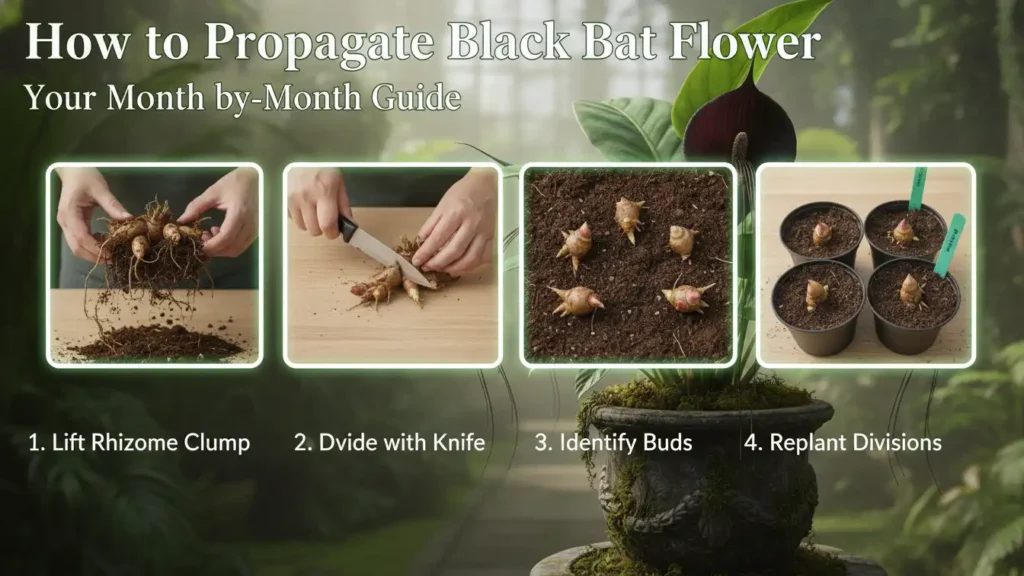
Want more of these gorgeous plants? Learning propagation techniques expands your black bat flower care skills to the next level.
Method 1: Rhizome Division (Easiest & Fastest)
Best time: Early spring, just as new growth begins
Step-by-step:
- Remove plant from pot and gently shake off soil
- Identify natural divisions in the rhizome clump
- Using a sharp, sterilized knife, cut rhizomes into sections
- Each section MUST have at least one growth bud (little bump or emerging shoot)
- Dust cut surfaces with cinnamon or sulfur powder (prevents rot)
- Plant each division in its own pot with fresh black bat flower soil mix
- Water lightly and keep warm (70-75°F)
- Don’t fertilize for first 4-6 weeks
- Keep humidity high
- Expect new growth in 3-8 weeks
Success rate: High (70-80%) if you follow these steps
Time to flowering: 1-2 years for divisions to reach flowering size
Method 2: Growing from Seed (For the Patient)
Reality check: This method takes MUCH longer and has lower success rates. But if you’re up for a challenge…
Step-by-step:
- Collect seeds from mature, dried seed pods (let pods dry on plant)
- Soak seeds in warm water for 24 hours before planting
- Fill small pots with seed-starting mix (or your bat flower soil recipe)
- Plant seeds 1/8 inch deep
- Cover pots with plastic to maintain humidity
- Place on seedling heat mat set to 75-80°F (bottom heat is ESSENTIAL)
- Keep in bright, indirect light
- Keep soil consistently moist but not soggy
- Be patient—germination takes 1-9 months (yes, really)
- Once sprouted, gradually acclimate seedlings to normal conditions
- Transplant to individual pots when they have 2-3 leaves
Success rate: Low to moderate (30-50%)
Time to flowering: 2-3 years minimum
Why rhizome division is better: It’s faster, easier, and you’re guaranteed the same genetics as your parent plant. Seeds can be variable.
Where to Buy Black Bat Flower Plants
Finding these rare beauties can be part of your black bat flower care journey!
Best sources:
Online Nurseries:
- Easy To Grow Bulbs
- Spring Hill Nursery
- Etsy sellers (search “Tacca chantrieri rhizome”)
- Logee’s Tropical Plants
- Plant Delights Nursery
Local Options:
- Specialty plant shops
- Botanical garden plant sales
- Orchid shows (they often have unusual tropicals)
- Plant swaps and collector groups
What to look for:
- Healthy rhizomes with visible growth buds
- Green, undamaged foliage (if buying established plant)
- No signs of rot or disease
- Reputable seller with good reviews
Price expectations:
- Rhizomes: $15-30
- Small plants: $25-40
- Mature, blooming-size plants: $50-100+
Pro tip: Join Facebook groups or online forums for rare plant collectors. Members often sell or trade divisions of their black bat flowers for much better prices than commercial nurseries.
Black Bat Flower Care: Quick Troubleshooting Flowchart
Plant looks sad →
- Check soil moisture first
- Too dry? → Water thoroughly
- Too wet? → Let dry out; improve drainage
- Just right? → Move to step 2
- Check leaves for clues
- Crispy brown edges? → Low humidity or underwatering
- Mushy yellow leaves? → Overwatering or root rot
- Pale, washed-out color? → Too much light or nutrients needed
- Droopy but moist? → Root rot; unpot and inspect
- Check environment
- Below 60°F? → Move to warmer spot
- In direct sun? → Relocate to filtered light
- Near vent? → Move away from drafts
- Humidity below 50%? → Add humidifier or pebble tray
- Check for pests
- See bugs? → Treat accordingly
- See damage but no bugs? → May be slugs at night
- Webbing? → Spider mites
- Consider timing
- Winter? → Probably dormant (normal)
- Just repotted? → May be adjusting (give it 2-4 weeks)
- Recently moved? → May be stressed (maintain consistency)
Advanced Black Bat Flower Care Tips
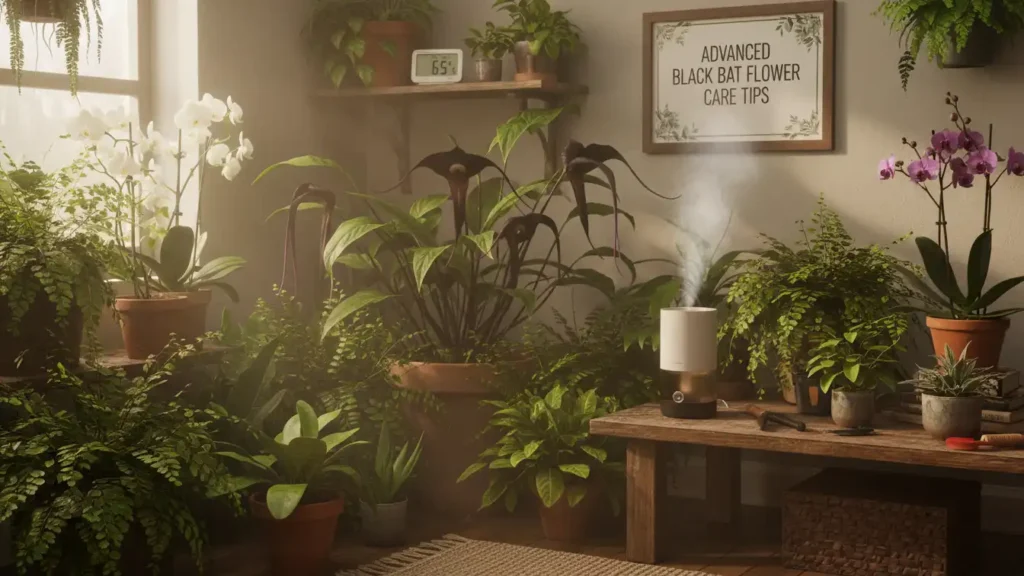
Once you’ve mastered the basics, try these pro-level techniques:
Tip #1: The “Double Pot” Method
Place your planted pot inside a slightly larger decorative pot with pebbles and water at the bottom. This creates a self-humidifying system and protects the plant from temperature fluctuations.
Tip #2: Seasonal Light Adjustment
Move your plant slightly closer to windows in winter (more light needed when days are shorter) and slightly farther in summer (protecting from intense rays).
Tip #3: The Bloom-Forcing Technique
Once your plant is mature, you can sometimes encourage additional blooms by:
- Providing a 4-6 week “dry” period (not bone dry, just drier)
- Then resuming normal watering
- This mimics natural dry-season/wet-season cycles
Tip #4: Create a “Humidity Corner”
Group your Black Bat Flower with other humidity-loving plants (orchids, ferns, calatheas) and run a humidifier nearby. This creates a microclimate where all plants thrive together.
Tip #5: Mulch the Surface
Add a thin layer of sphagnum moss or fine pine bark on the soil surface. This helps retain moisture and mimics the forest floor environment these plants love.
Frequently Asked Questions About Black Bat Flower Care
Is the Black Bat Flower toxic to pets?
Yes, mildly. It contains calcium oxalate crystals that can cause irritation if chewed. Keep away from curious cats and dogs. While not deadly, it can cause drooling, vomiting, and mouth irritation.
Can I grow Black Bat Flower outdoors year-round?
Only in USDA zones 9b-11 where temperatures never drop below 55°F. In colder zones, grow in pots and bring inside for winter.
How long do the flowers last?
Each bloom lasts 3-6 weeks. A mature, happy plant can produce up to 8 blooms per growing season, giving you months of flowers!
Why are the whiskers on my Black Bat Flower shorter than pictures I see online?
Whisker length varies based on genetics and growing conditions. Better light and nutrition can lead to longer whiskers, but some plants naturally produce shorter ones. Both are beautiful!
Should I stake the flower stems?
You can! The tall flower scapes can benefit from support, especially in windy conditions. Use thin bamboo stakes and soft ties.
Can I grow this from a cutting?
Not reliably. These plants grow from rhizomes, not stem cuttings. Rhizome division is your best propagation method.
Do I need to hand-pollinate the flowers?
Black Bat Flowers are primarily self-pollinating (they pollinate themselves before the flower fully opens). If you want seeds, just let the flowers mature naturally and seed pods will form.
The flower color isn’t truly black—is something wrong?
Nope! “Black” is a bit of a misnomer. Flowers are typically deep purple, maroon, or dark brown—appearing black in certain lighting. True botanical black doesn’t really exist in nature.
Final Thoughts: You Can Master Black Bat Flower Care!
Look, I’m not going to lie and say this is the easiest houseplant you’ll ever grow. Learning how to care for black bat flower takes attention, consistency, and patience.
But here’s what I know for sure: when that first otherworldly bloom emerges, with its dramatic wing-like bracts and those impossibly long whiskers swaying gently, you’ll understand why this plant has captured the hearts of collectors worldwide.
Every challenging moment of black bat flower care—the humidity monitoring, the careful watering, the months of waiting—suddenly feels worth it.
These plants reward dedicated care with
How to Care for Black Bat Flower: The Ultimate Growing Guide That Actually Works
If you’ve stumbled across the mesmerizing Black Bat Flower and wondered whether you could actually keep this gothic beauty alive, you’re in the right place. Trust me, I get it—this plant looks like it requires a degree in horticulture and a prayer to the plant gods.
But here’s the truth: learning how to care for black bat flower isn’t as scary as those dramatic blooms might suggest.
With the right approach (and a little patience), you can absolutely master black bat flower care and watch those eerie, wing-shaped blooms emerge season after season.
Let me walk you through everything you need to know, from the basics to the pro-level tricks that’ll make your neighbors green with envy.
What Makes the Black Bat Flower So Special?
Before we dive into how to care for black bat flower plants, let’s appreciate what makes this specimen so extraordinary.
The Black Bat Flower (Tacca chantrieri) isn’t just unusual—it’s downright theatrical. Native to the steamy rainforests of Southeast Asia, including Thailand, Malaysia, and southern China, this member of the yam family (Dioscoreaceae) produces flowers that look like they were designed for a Tim Burton film.
Each bloom can reach up to 12 inches across, with deep blackish-purple petals (technically bracts) that resemble bat wings in flight. But the real showstopper? Those long, thread-like whiskers—called bracteoles—that can dangle down over 2 feet, giving the flower an otherworldly, almost sinister appearance.
Other common names for this beauty include:
- Devil Flower
- Cat’s Whiskers
- Tiger Beard
- Bat Head Lily
- Voodoo Flower
The plant itself grows from fleshy rhizomes and can reach 24-36 inches tall with glossy, lance-shaped leaves that create a lush tropical backdrop for those dramatic blooms.
Fun fact: There’s also a White Bat Flower (Tacca integrifolia) that’s even larger but notoriously fussier to grow. The white variety can reach 36-48 inches tall but flowers less frequently than its black counterpart.
Is the Black Bat Flower Right for You?
Let’s be real for a second. Learning how to care for black bat flower successfully requires honest self-assessment.
This isn’t a “set it and forget it” houseplant like a pothos or snake plant. The Black Bat Flower is what I call a “relationship plant”—it needs consistent attention and specific conditions to thrive.
You’ll love growing this plant if you:
- Enjoy unique, conversation-starting specimens
- Can maintain consistent humidity levels
- Have patience (blooms can take 6-12 months to appear)
- Love the thrill of successfully growing “difficult” plants
- Have bright, indirect light available
- Are willing to check on your plant regularly
Maybe choose something else if you:
- Travel frequently without plant-sitters
- Have very dry indoor air with no way to humidify
- Only have sunny, south-facing windows
- Prefer low-maintenance plants
- Get discouraged easily
If you’re still reading, fantastic! You’ve got the right mindset for black bat flower care success.
Black Bat Flower Care Requirements at a Glance
Here’s your quick-reference guide for how to care for black bat flower:
Care AspectRequirementLightBright, indirect light; dappled shade; no direct sunWaterKeep evenly moist; top inch can dry slightlyHumidityHigh (60-80%); minimum 50%Temperature70-85°F (21-29°C); never below 55°F (13°C)SoilRich, well-draining, organic mixFertilizerEvery 2-4 weeks during growing seasonUSDA Zones9b-11 (indoors elsewhere)BloomingLate spring through fall; up to 8 times per seasonToxicityMildly toxic to pets; contains calcium oxalate
Now let’s break down each element of proper black bat flower care in detail.
The 7 Essential Elements of Black Bat Flower Care
1. Light: Finding That Perfect Jungle Floor Glow
If there’s one thing that’ll make or break your black bat flower care routine, it’s getting the lighting right.
Remember, in its native habitat, this plant grows on the rainforest floor beneath a thick canopy. It’s evolved to thrive in filtered, dappled light—never harsh, direct sun.
What “bright, indirect light” actually means:
- Near an east-facing window (ideal for morning gentleness)
- A few feet back from a south or west-facing window
- Near a north-facing window with additional ambient light
- Under a shade tree outdoors (in warm climates)
Signs your lighting is wrong:
- Too much light: Leaves develop brown, crispy edges or bleached-looking spots; leaves may curl inward
- Too little light: No blooms despite proper care elsewhere; leggy, stretched growth; pale, yellowish leaves
Pro tip: I’ve found that sheer curtains work beautifully for filtering strong light. You want the plant to cast a soft, fuzzy shadow—not a sharp one—which indicates perfect brightness without intensity.
For indoor growing, placing your black bat flower near an eastern window has given me the best results. The gentle morning sun filtered through leaves outside creates that perfect dappled effect.
2. Watering: The Goldilocks Challenge
Here’s where many people struggle with how to care for black bat flower: the watering dance.
This plant wants consistently moist soil—not wet, not dry, but that perfect “just right” sweet spot. Think of a wrung-out sponge rather than a soaking-wet one.
The proper watering technique:
- Check the top inch of soil with your finger
- If it feels dry to the touch, it’s time to water
- Water thoroughly until excess drains from the bottom
- Empty the drainage saucer after 15 minutes (no standing water!)
- Wait until the top inch dries slightly before watering again
Seasonal adjustments:
- Spring through summer (active growth): Water more frequently, possibly every 3-5 days
- Fall and winter (dormancy): Reduce watering significantly, possibly once every 7-10 days, but never let soil completely dry out
Common watering mistakes in black bat flower care:
❌ Overwatering → Leads to root rot (the #1 killer)
- Signs: Mushy, yellowing leaves; foul-smelling soil; black, slimy roots
❌ Underwatering → Causes stress and prevents blooming
- Signs: Crispy leaf tips; leaves dropping prematurely; wilting despite moist air
❌ Inconsistent watering → Confuses the plant and stunts growth
- Signs: Erratic growth; leaf tip browning; reduced flowering
Water quality matters too: Black bat flowers prefer slightly acidic conditions, so if you have hard tap water, consider using filtered water or letting tap water sit out for 24 hours before using it.
The saucer method: Some growers keep their pots sitting in saucers with pebbles and a bit of water (pot bottom not touching water). This provides both humidity and a visual reminder of the plant’s moisture needs—when the saucer dries out, check if watering is needed.
3. Humidity: Creating Your Indoor Rainforest
If you want to truly master how to care for black bat flower, you absolutely must address humidity. This is non-negotiable.
These plants evolved in tropical rainforests where humidity hovers between 60-80%. Most homes sit around 30-40% humidity, especially in winter with heating systems running.
The humidity hierarchy (from least to most effective):
Basic Level: Grouping & Misting
- Group your bat flower with other tropical plants to create a microclimate
- Mist around (not directly on) the plant daily
- Effectiveness: 3/10 (temporary, requires daily commitment)
Intermediate Level: Pebble Trays
- Fill a wide, shallow tray with pebbles
- Add water until it’s just below the top of the pebbles
- Place your pot on top (bottom not touching water)
- As water evaporates, humidity rises around the plant
- Effectiveness: 6/10 (helps but limited range)
Advanced Level: Humidifiers
- Use a cool-mist humidifier near your plant
- Run it especially during heating season
- Aim for 60-70% relative humidity
- Effectiveness: 9/10 (consistent, measurable results)
Expert Level: Enclosed Growing
- Grow in a terrarium (for smaller specimens)
- Use a grow tent with humidity control
- Create a dedicated “humidity corner” with multiple plants and a humidifier
- Effectiveness: 10/10 (perfect control but requires space)
How to measure humidity: Get a simple hygrometer (they’re under $10 on Amazon). Place it near your plant and check it regularly. If it consistently reads below 50%, your black bat flower will struggle.
Signs of low humidity:
- Crispy, brown leaf edges and tips
- Leaves curling inward
- Stunted growth
- No blooming despite other conditions being met
- Overall droopy, sad appearance
My personal setup: I run a humidifier during the day near my tropical plant corner, where my Black Bat Flower sits with orchids and ferns. This creates a consistently humid microclimate that keeps everyone happy.
4. Temperature: Keeping Things Tropical Year-Round
Black bat flower care requires consistent warmth—these plants are seriously cold-sensitive.
Ideal temperature range:
- Summer: 77-85°F (25-29°C)
- Winter: 65-70°F (18-21°C)
- Absolute minimum: Never below 55°F (13°C)
Temperatures below 55°F can cause permanent damage or death. Below 40°F is basically a death sentence for this tropical beauty.
Temperature considerations for black bat flower care:
✓ Keep away from:
- Air conditioning vents (cold drafts)
- Heating vents (hot, dry air)
- Drafty windows in winter
- Exterior doors that open frequently
- Unheated sunrooms or garages
✓ Best locations:
- Interior rooms with stable temps
- Bathrooms with good light (bonus humidity!)
- Climate-controlled sunrooms
- Near other heat-loving plants
Seasonal temperature tips:
- Summer outdoor placement: Can go outside in zones 9-11, but watch nighttime temps
- Winter protection: Move away from windows; consider a plant heating mat if your home gets chilly
- Transitioning seasons: When bringing plants inside for fall, acclimate gradually over 1-2 weeks
The “microclimate check”: Place your hand where the plant sits at different times of day. Does it feel drafty? Unusually hot or cold? Your hand is a great temperature sensor for identifying problem spots.
5. Soil: Building the Perfect Foundation
Getting the soil right is crucial for successful black bat flower care. These plants need a mix that drains quickly yet retains some moisture—basically, the Goldilocks of potting media.
What NOT to use:
- ❌ Standard potting soil alone (too heavy, holds too much water)
- ❌ Garden soil or “native” soil (way too dense)
- ❌ Cactus/succulent mix (drains too quickly)
- ❌ Anything without drainage amendments
Perfect Black Bat Flower Soil Recipes:
Recipe #1: The Standard Mix
- 50% peat moss or coco coir
- 30% perlite
- 20% pine bark fines
- Optional: handful of worm castings for nutrition
Recipe #2: The Orchid-Inspired Mix
- 40% peat moss
- 40% orchid bark mix
- 10% perlite
- 10% sand or fine vermiculite
Recipe #3: The Ready-Made Solution
- African violet potting mix (straight from the bag!)
- Add a handful of perlite per quart of mix
- This is my go-to for simplicity
Recipe #4: The Premium Blend
- 50% pine bark (small pieces)
- 40% peat moss
- 10% coarse sand
- Sprinkle of charcoal for freshness
Why these ingredients matter:
- Peat moss/Coco coir: Retains moisture while staying light
- Perlite: Creates air pockets, prevents compaction
- Pine bark: Mimics natural forest floor material
- Sand: Improves drainage without being too fast
- Vermiculite: Holds moisture and nutrients
Soil pH: Black bat flowers prefer slightly acidic conditions (pH 6.1-7.5). Most peat-based mixes fall naturally into this range.
Repotting tips for black bat flower care:
- Repot every spring for best results (fresh nutrients!)
- Use a wide, shallow pot rather than deep (rhizomes spread horizontally)
- Don’t pot up too dramatically—go up just one size
- These plants bloom better when slightly pot-bound (but not root-bound)
6. Fertilizing: Feeding Your Dramatic Beauty
Proper fertilization is a key component of comprehensive black bat flower care, especially during the growing and blooming seasons.
Fertilizer schedule:
- Spring through early fall: Every 2 weeks
- Late fall through winter: Stop feeding (dormancy period)
Best fertilizer types:
Option 1: Balanced Water-Soluble Fertilizer
- Use 10-20-10 or 20-20-20 ratio
- Dilute to HALF strength
- Apply when watering every other week
Option 2: Orchid Fertilizer
- These work brilliantly for bat flowers
- They’re formulated for similar growing conditions
- Use as directed, but consider diluting to 3/4 strength
Option 3: Slow-Release Granules
- Apply once at the start of growing season
- Less fuss, but less control
- Use formulas designed for flowering tropical plants
Why dilute? Black bat flowers have relatively sensitive roots. Strong fertilizer can burn them, causing more harm than good. It’s always better to under-feed slightly than over-feed.
Signs of fertilizer issues:
Over-fertilized:
- White crusty buildup on soil surface
- Brown, crispy leaf tips
- Salt accumulation at pot rim
- Stunted growth (counterintuitively)
Under-fertilized:
- Pale, yellowing leaves (not just old ones)
- Weak, leggy growth
- No blooms despite perfect other conditions
- Very slow growth
Pro fertilizer tip: Every 2-3 months, flush your pot with plain water (pour water through until it drains out the bottom several times). This rinses away salt buildup from fertilizer and prevents root burn.
7. Patience and Observation: The Secret Ingredient
Here’s something most guides on how to care for black bat flower don’t tell you: patience is genuinely your most important tool.
This plant operates on its own timeline. Even with perfect care, you might wait 6-12 months (or longer!) for your first bloom. Young plants grown from rhizomes typically take 2-3 years to reach flowering maturity.
What to expect in Year 1:
- Months 1-3: Establishment phase; focus on root development
- Months 4-6: New leaf growth; plant gaining size
- Months 7-9: Continued vegetative growth
- Months 10-12: Possible first blooms (if plant is mature enough) or continued vegetative growth
The blooming reality: Once mature and happy, your Black Bat Flower can bloom up to 8 times in a single growing season. Each bloom lasts several weeks. But getting to that “happy place” requires mastering all aspects of black bat flower care.
Observation is your superpower: Spend 5 minutes every few days really looking at your plant. Check for:
- New growth emerging from the center
- Leaf color changes
- Soil moisture levels
- Signs of pests or disease
- Overall “vibe” (yes, plants have vibes!)
The more you observe, the better you’ll understand what your specific plant needs in your specific environment.
Seasonal Black Bat Flower Care: Your Month-by-Month Guide
Understanding seasonal changes is essential for year-round black bat flower care success.
Spring (March-May)
The Wake-Up Season
This is when your Black Bat Flower exits dormancy and gears up for growth.
✓ Begin regular fertilizing (every 2 weeks) ✓ Increase watering frequency as days warm ✓ Repot if needed (early spring is ideal) ✓ Divide rhizomes for propagation if desired ✓ Move to brighter location if it was in dimmer winter spot ✓ Resume full humidity regimen
What to expect: New leaves emerging from rhizomes; increased growth rate; possibly early blooms by late spring
Summer (June-August)
The Glory Season
Peak growing and blooming time for black bat flower care efforts to pay off.
✓ Maintain consistent moisture (may need daily watering in heat) ✓ Keep fertilizing every 2 weeks ✓ Monitor humidity closely (AC can dry air) ✓ Ensure shading from hot afternoon sun ✓ Check for flower stalks emerging ✓ Can move outdoors to shaded patio (zones 9-11)
What to expect: Multiple blooms appearing; vigorous leaf growth; plant at its absolute best
Fall (September-November)
The Transition Season
The plant begins preparing for its rest period.
✓ Gradually reduce watering frequency ✓ Stop fertilizing by late October
✓ Bring outdoor plants inside before temps drop below 55°F ✓ Late-season blooms may still appear ✓ Watch for dormancy signs (slowed growth)
What to expect: Blooming tapers off; growth slows; plant enters semi-dormant state
Winter (December-February)
The Rest Season
Black bat flower care shifts to maintenance mode during dormancy.
✓ Water sparingly—let top 1-2 inches dry between waterings ✓ No fertilizer at all ✓ Maintain warmth (never below 55°F) ✓ Keep humidity moderate (50%+ still important) ✓ Provide as much indirect light as possible ✓ Don’t panic if it loses a leaf or two
What to expect: Minimal to no growth; plant “resting”; in very warm climates, may stay semi-active
Important dormancy note: In consistently warm, humid climates (like Florida or Hawaii), Black Bat Flowers may not experience full dormancy. They’ll remain evergreen and might even produce occasional blooms. Adjust your care accordingly based on your climate and what your plant is actually doing.
Common Black Bat Flower Problems (And How to Fix Them)
Even with perfect black bat flower care, issues can arise. Here’s your troubleshooting guide.
Yellow Leaves
Most likely causes:
- Underwatering (most common)
- Fix: Water more consistently; check soil daily
- Signs: Dry soil, crispy leaf edges too
- Overwatering / Root rot
- Fix: Reduce watering; improve drainage; check roots for rot
- Signs: Mushy leaves, foul soil smell, constant wetness
- Nutrient deficiency
- Fix: Resume fertilizing schedule if you’ve been skipping it
- Signs: Overall pale appearance, slow growth
- Natural aging
- Fix: None needed! Old leaves naturally yellow and drop
- Signs: Only oldest, lower leaves affected
Brown Spots on Leaves
Most likely causes:
- Sunburn
- Appearance: Dry, crispy brown patches on leaves facing light
- Fix: Move to less bright location or add sheer curtain
- Fungal infection
- Appearance: Wet-looking dark spots, possibly with yellow halos
- Fix: Improve air circulation; reduce humidity slightly; remove affected leaves; apply copper fungicide if severe
- Overwatering
- Appearance: Brown, mushy spots; general droopiness
- Fix: Reduce watering; ensure proper drainage
Leaves Dropping or Falling Over
Most likely causes:
- Temperature stress
- Cold drafts or temps below 55°F
- Fix: Move to warmer, draft-free location
- Watering issues
- Either too much or too little
- Fix: Adjust watering; check soil moisture daily
- Low humidity
- Leaves dropping to conserve moisture
- Fix: Increase humidity immediately
- Root problems
- Root rot or severe root-bound condition
- Fix: Unpot and inspect roots; trim damaged parts; repot in fresh soil
No Blooms (Despite Good Care)
Most likely causes:
- Plant is too young
- Needs 2-3 years to mature from rhizome
- Fix: Patience! Keep providing excellent care
- Insufficient light
- Won’t bloom in too-dim conditions
- Fix: Move to brighter (but still indirect) location
- Wrong temperature
- Needs consistent warmth to bloom
- Fix: Ensure temps stay 70-85°F during growing season
- Not enough leaves
- Plant needs at least 2-3 mature leaves before blooming
- Fix: Focus on vegetative growth first
- Dormancy interruption
- Needs winter rest period to bloom properly
- Fix: Allow proper dormancy (reduce water, stop fertilizer in winter)
Wilting Despite Moist Soil
Most likely cause: Root rot
This is the #1 killer in black bat flower care.
How to save a plant with root rot:
- Remove plant from pot immediately
- Shake off all old soil
- Inspect roots—healthy roots are firm and white/tan
- Cut away any black, mushy, or smelly roots with sterilized scissors
- Let plant air-dry for a few hours
- Repot in completely fresh, well-draining soil
- Water lightly and keep in warm, bright spot
- Reduce watering frequency going forward
- Improve pot drainage (more holes, better soil)
Prevention: This is why proper soil and watering are so crucial in black bat flower care!
Pests
Black bat flowers are generally pest-resistant, but problems can occur:
Aphids
- Small green/black bugs on new growth
- Fix: Spray off with water; use insecticidal soap
Spider mites
- Tiny dots on undersides of leaves; fine webbing
- Fix: Increase humidity (they hate it); spray with neem oil
Fungus gnats
- Little flies around soil surface
- Fix: Let soil dry more between waterings; use mosquito bits in water
Slugs and snails (outdoor growing)
- Holes in leaves; slime trails
- Fix: Hand-pick; use slug bait; create copper barriers
How to Propagate Black Bat Flower
Want more of these gorgeous plants? Learning propagation techniques expands your black bat flower care skills to the next level.
Method 1: Rhizome Division (Easiest & Fastest)
Best time: Early spring, just as new growth begins
Step-by-step:
- Remove plant from pot and gently shake off soil
- Identify natural divisions in the rhizome clump
- Using a sharp, sterilized knife, cut rhizomes into sections
- Each section MUST have at least one growth bud (little bump or emerging shoot)
- Dust cut surfaces with cinnamon or sulfur powder (prevents rot)
- Plant each division in its own pot with fresh black bat flower soil mix
- Water lightly and keep warm (70-75°F)
- Don’t fertilize for first 4-6 weeks
- Keep humidity high
- Expect new growth in 3-8 weeks
Success rate: High (70-80%) if you follow these steps
Time to flowering: 1-2 years for divisions to reach flowering size
Method 2: Growing from Seed (For the Patient)
Reality check: This method takes MUCH longer and has lower success rates. But if you’re up for a challenge…
Step-by-step:
- Collect seeds from mature, dried seed pods (let pods dry on plant)
- Soak seeds in warm water for 24 hours before planting
- Fill small pots with seed-starting mix (or your bat flower soil recipe)
- Plant seeds 1/8 inch deep
- Cover pots with plastic to maintain humidity
- Place on seedling heat mat set to 75-80°F (bottom heat is ESSENTIAL)
- Keep in bright, indirect light
- Keep soil consistently moist but not soggy
- Be patient—germination takes 1-9 months (yes, really)
- Once sprouted, gradually acclimate seedlings to normal conditions
- Transplant to individual pots when they have 2-3 leaves
Success rate: Low to moderate (30-50%)
Time to flowering: 2-3 years minimum
Why rhizome division is better: It’s faster, easier, and you’re guaranteed the same genetics as your parent plant. Seeds can be variable.
Where to Buy Black Bat Flower Plants
Finding these rare beauties can be part of your black bat flower care journey!
Best sources:
Online Nurseries:
- Easy To Grow Bulbs
- Spring Hill Nursery
- Etsy sellers (search “Tacca chantrieri rhizome”)
- Logee’s Tropical Plants
- Plant Delights Nursery
Local Options:
- Specialty plant shops
- Botanical garden plant sales
- Orchid shows (they often have unusual tropicals)
- Plant swaps and collector groups
What to look for:
- Healthy rhizomes with visible growth buds
- Green, undamaged foliage (if buying established plant)
- No signs of rot or disease
- Reputable seller with good reviews
Price expectations:
- Rhizomes: $15-30
- Small plants: $25-40
- Mature, blooming-size plants: $50-100+
Pro tip: Join Facebook groups or online forums for rare plant collectors. Members often sell or trade divisions of their black bat flowers for much better prices than commercial nurseries.
Black Bat Flower Care: Quick Troubleshooting Flowchart
Plant looks sad →
- Check soil moisture first
- Too dry? → Water thoroughly
- Too wet? → Let dry out; improve drainage
- Just right? → Move to step 2
- Check leaves for clues
- Crispy brown edges? → Low humidity or underwatering
- Mushy yellow leaves? → Overwatering or root rot
- Pale, washed-out color? → Too much light or nutrients needed
- Droopy but moist? → Root rot; unpot and inspect
- Check environment
- Below 60°F? → Move to warmer spot
- In direct sun? → Relocate to filtered light
- Near vent? → Move away from drafts
- Humidity below 50%? → Add humidifier or pebble tray
- Check for pests
- See bugs? → Treat accordingly
- See damage but no bugs? → May be slugs at night
- Webbing? → Spider mites
- Consider timing
- Winter? → Probably dormant (normal)
- Just repotted? → May be adjusting (give it 2-4 weeks)
- Recently moved? → May be stressed (maintain consistency)
Advanced Black Bat Flower Care Tips
Once you’ve mastered the basics, try these pro-level techniques:
Tip #1: The “Double Pot” Method
Place your planted pot inside a slightly larger decorative pot with pebbles and water at the bottom. This creates a self-humidifying system and protects the plant from temperature fluctuations.
Tip #2: Seasonal Light Adjustment
Move your plant slightly closer to windows in winter (more light needed when days are shorter) and slightly farther in summer (protecting from intense rays).
Tip #3: The Bloom-Forcing Technique
Once your plant is mature, you can sometimes encourage additional blooms by:
- Providing a 4-6 week “dry” period (not bone dry, just drier)
- Then resuming normal watering
- This mimics natural dry-season/wet-season cycles
Tip #4: Create a “Humidity Corner”
Group your Black Bat Flower with other humidity-loving plants (orchids, ferns, calatheas) and run a humidifier nearby. This creates a microclimate where all plants thrive together.
Tip #5: Mulch the Surface
Add a thin layer of sphagnum moss or fine pine bark on the soil surface. This helps retain moisture and mimics the forest floor environment these plants love.
Frequently Asked Questions About Black Bat Flower Care
Is the Black Bat Flower toxic to pets?
Yes, mildly. It contains calcium oxalate crystals that can cause irritation if chewed. Keep away from curious cats and dogs. While not deadly, it can cause drooling, vomiting, and mouth irritation.
Can I grow Black Bat Flower outdoors year-round?
Only in USDA zones 9b-11 where temperatures never drop below 55°F. In colder zones, grow in pots and bring inside for winter.
How long do the flowers last?
Each bloom lasts 3-6 weeks. A mature, happy plant can produce up to 8 blooms per growing season, giving you months of flowers!
Why are the whiskers on my Black Bat Flower shorter than pictures I see online?
Whisker length varies based on genetics and growing conditions. Better light and nutrition can lead to longer whiskers, but some plants naturally produce shorter ones. Both are beautiful!
Should I stake the flower stems?
You can! The tall flower scapes can benefit from support, especially in windy conditions. Use thin bamboo stakes and soft ties.
Can I grow this from a cutting?
Not reliably. These plants grow from rhizomes, not stem cuttings. Rhizome division is your best propagation method.
Do I need to hand-pollinate the flowers?
Black Bat Flowers are primarily self-pollinating (they pollinate themselves before the flower fully opens). If you want seeds, just let the flowers mature naturally and seed pods will form.
The flower color isn’t truly black—is something wrong?
Nope! “Black” is a bit of a misnomer. Flowers are typically deep purple, maroon, or dark brown—appearing black in certain lighting. True botanical black doesn’t really exist in nature.
Final Thoughts: You Can Master Black Bat Flower Care!
Look, I’m not going to lie and say this is the easiest houseplant you’ll ever grow. Learning how to care for black bat flower takes attention, consistency, and patience.
But here’s what I know for sure: when that first otherworldly bloom emerges, with its dramatic wing-like bracts and those impossibly long whiskers swaying gently, you’ll understand why this plant has captured the hearts of collectors worldwide.
Every challenging moment of black bat flower care—the humidity monitoring, the careful watering, the months of waiting—suddenly feels worth it.
These plants reward dedicated care with some of the most unique, conversation-starting blooms you’ll ever witness.
Your black bat flower care journey starts with three fundamental principles:
- Mimic the rainforest: High humidity, filtered light, consistent warmth
- Be consistent: These plants thrive on routine, not surprises
- Stay patient: Great things (like gothic bat blooms) take time
Start with getting the basics right—proper soil, good drainage, adequate humidity—and build from there. Don’t try to perfect everything at once. Focus on one element at a time until it becomes second nature.
Most importantly? Don’t get discouraged if your first attempt doesn’t go perfectly. Even experienced growers lose Black Bat Flowers sometimes. It’s part of the learning process.
The fact that you’ve read this entire guide tells me you have the dedication to succeed. You’re not looking for shortcuts—you’re looking for real, actionable information on how to care for black bat flower properly.
That mindset is exactly what this extraordinary plant needs.
Now go forth and grow some gloriously gothic blooms! And when visitors stop dead in their tracks, staring at your mysterious Black Bat Flower with wonder (and maybe a little bit of fear), you’ll know all your black bat flower care efforts were absolutely worth it.
Pin This Guide for Later!
Save this complete guide on how to care for black bat flower to your gardening Pinterest board so you can reference it anytime you need help with your dramatic tropical beauty!
Have you successfully grown a Black Bat Flower? What’s your #1 black bat flower care tip for beginners? Share your experience in the comments below—we’d love to hear your story!