
12 Things You Should Never Do in the Morning

Mornings quietly set the tone for your entire day.
Not in a “5 a.m. miracle routine” way—but in a small, subtle “how you treat yourself right after you wake up” way.
If your mornings usually start with rushing, scrolling, panicking, or skipping everything that would actually help you feel human… it makes sense that the rest of the day feels a bit off.
This isn’t about being perfect or becoming a morning person overnight.
It’s about gently noticing a few things you do in the morning that might be draining your energy, your focus, and your mood more than you realise.
What Are the Things You Should Never Do in the Morning?
The morning sets the tone for your entire day, which is why knowing the things you should never do in the morning is just as important as building good habits. Most people unknowingly start their day with behaviours that increase stress, drain energy, and make them feel behind before they even begin. Spotting these patterns early helps you reset your routine and create a calmer, more intentional start.
Let’s walk through 12 things you should never do in the morning if you want your day to feel calmer, kinder, and more grounded—without adding a 27-step routine to your plate.
Hitting Snooze Over and Over Again
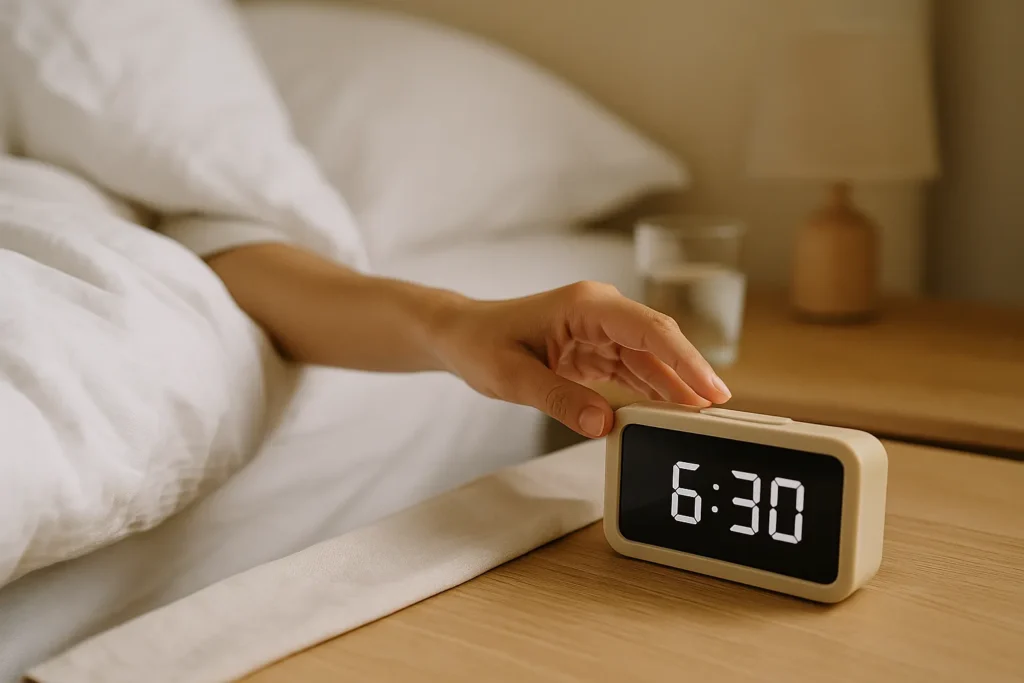
It feels harmless: “Just 5 more minutes.”
But those tiny snoozes add up—not only in time, but in how you feel.
When you drift in and out of shallow sleep, your brain doesn’t fully rest or fully wake up. You often end up feeling groggier than if you had just gotten up the first time. And mentally, you start the day with a mini pattern of avoidance: “I don’t want to deal with this yet.”
If you can, set your alarm for the actual time you need to wake up and commit to getting up on the first or second ring. Even one less snooze is a win. Over time, your brain starts to trust that when morning comes, you’re actually getting up—no drama.
Grabbing Your Phone Before You Even Sit Up

Reaching for your phone the second your eyes open is one of the quickest ways to hand your mood over to everything and everyone else.
You haven’t even checked in with yourself yet, and suddenly you’re:
- reading messages
- seeing notifications
- scrolling through other people’s lives
- absorbing news, opinions, and noise
Your nervous system goes from zero to overloaded in under a minute.
Instead, try giving yourself even 5–10 phone-free minutes when you wake up. Sit up, stretch, breathe, drink some water, look out the window—anything that lets you arrive in your day before the rest of the world does.
Skipping Water and Going Straight to Caffeine

Coffee or chai first thing is a love language, but your body has just gone hours without water while you slept. Going straight to caffeine without hydrating can leave you feeling more jittery, dehydrated, and tired later.
You don’t need to stop enjoying your morning drink. Just try to:
- drink a glass of water before or alongside it
- keep a bottle or glass near your bed or in the kitchen
- treat that first sip of water as a tiny “I’m taking care of you” moment
It’s such a small shift, but your body will feel the difference—especially as the day goes on.
Checking Email, Messages, or Work Tasks Immediately

The moment you open your inbox in the morning, your brain flips into reaction mode. Instead of easing into the day, you’re suddenly:
- mentally at work before you’re even properly awake
- absorbing requests, problems, and expectations
- letting other people’s urgency set your priorities
You’re allowed to have a small buffer between “I woke up” and “I’m available for everyone else.”
Try giving yourself even 15–30 minutes before you check email or work apps. Use that time to wake up slowly, move your body, eat, or simply sit in silence. Work will still be there—but you’ll arrive in a much better headspace.
Beating Yourself Up for How You Slept

Bad night? Weird dreams? Scrolled too late?
It happens.
But starting your morning by attacking yourself—“Why did I stay up so late? I’m so stupid. I’m going to be useless today.”—only adds more weight to a body that’s already tired.
You can acknowledge the reality (“I’m more tired than I’d like today”) without making it a personal failure. Then gently ask, “Okay, what would support me today knowing I’m low on sleep?”
Maybe it’s extra water, simpler tasks, a short walk, or an earlier bedtime tonight. Kindness works better than self-punishment every single time.
Rushing So Much You Don’t Even Breathe

Some mornings are genuinely busy. Kids, commute, early meetings, responsibilities—it’s real.
But constantly running through your morning like a fire drill—no pause, no breath, no moment to actually arrive in your own life—teaches your nervous system that every day starts in emergency mode.
Even on the busiest mornings, see if you can find micro-pauses:
- one deep breath while your coffee brews
- 30 seconds to stretch your shoulders
- a slow inhale and exhale before you step out the door
You may not be able to slow down the schedule, but you can slow down your body for a moment inside of it.
Skipping Food (Or Only Grabbing Sugar)

Not everyone is hungry the second they wake up, and that’s okay. But going too long without any real fuel—or only having a sugary snack or drink—can leave you feeling shaky, irritable, and extra tired by mid-morning.
Your body has already been fasting overnight. It needs something grounding:
- a simple breakfast (eggs, toast, oats, yogurt, fruit)
- even a small snack if you’re not ready for a full meal
Think of it as giving your brain and body the minimum they need to function, especially on days that are already demanding. You deserve more than running on fumes.
Starting the Day in a Comparison Spiral

If your first real look at the world is social media, it’s very easy to slide straight into:
- “She’s more productive than me.”
- “Their life looks so put together.”
- “I’m already behind and it’s only 8 a.m.”
No one posts their full reality, especially in the morning. You’re comparing your unfiltered life to someone else’s highlight reel, and it’s not a fair fight.
If you can, delay social media until you’ve at least done one kind thing for yourself: made your bed, brushed your teeth, had water, eaten, or simply sat in quiet. Let your life exist first before you scroll through anyone else’s.
Letting One Small Thing Ruin the Whole Day

Spilled coffee.
Missed bus.
A comment that hit you wrong.
A kid meltdown or a rushed goodbye.
Mornings are fragile, and tiny inconveniences can feel way bigger than they are. But deciding “Well, the day is ruined now” because of one rough moment quietly steals hours you could still enjoy or at least salvage.
Instead, try to mentally contain the moment:
“That was annoying. I didn’t like that. But it’s just one part of my morning, not the whole day.”
You’re allowed to reset at 10 a.m., 2 p.m., or 7 p.m. A bad moment doesn’t have to become a bad day.
Filling Your Mind With Negativity Right Away

What you feed your mind first thing matters. If your morning starts with harsh self-talk, doom-scrolling, or stressful content, your body will respond as if the world is on fire—even if you’re just standing in your kitchen.
You don’t have to pretend everything is perfect. But you can choose softer inputs:
- calming music
- a podcast you enjoy
- a few lines from a book that makes you feel grounded
- a simple gratitude thought like, “I’m glad I have a bed,” or “I’m grateful for this warm drink.”
Again, this isn’t about toxic positivity. It’s about not pouring gasoline on your anxiety before the day has even begun.
Making Your Morning a Punishment Zone

If your mornings are crammed with everything you “should” do—intense workouts, strict routines, zero flexibility—it’s easy to start resenting that part of the day.
You don’t need a perfect 2-hour morning block to be “good.” You also don’t have to force yourself into habits that feel like punishment.
Instead, try to build a morning that feels like a mix of:
- something supportive (water, movement, food)
- something anchoring (a quiet moment, a bit of planning, a breath)
- something you actually enjoy (music, a warm drink, sunlight, a few pages of a book)
A morning doesn’t have to be aesthetic to be valuable. It just has to feel livable and kind.
Forgetting to Check In With Yourself at All

One of the most damaging things you can do in the morning is also the easiest to miss: never checking in with how you actually feel.
You might be pushing straight into tasks, roles, and responsibilities without pausing to ask:
- “How am I doing today?”
- “What do I need more of?” (rest, support, patience, food, quiet)
- “Is there anything I can lighten or simplify, knowing how I feel?”
A quick internal check-in doesn’t magically fix everything, but it does something important: it puts you back into the picture. You’re not just a body rushing around—you’re a human being with feelings, limits, and needs that matter.
Even a 30-second honest moment with yourself can change the way you move through the rest of your day.
A Gentle Note Before You Change Anything
You don’t have to fix all 12 things this week.
You don’t have to become a morning person.
You don’t have to copy anyone else’s routine.
Just notice which one or two points made your body quietly go, “Ouch… that’s me.” Start there.
Maybe it’s leaving your phone alone for the first 10 minutes.
Maybe it’s drinking water before coffee.
Maybe it’s stopping the habit of telling yourself “the day is ruined” before 9 a.m.
Small morning shifts have a way of quietly rippling into everything else.
Not because your life becomes perfect—but because you started your day by treating yourself with a little more care, attention, and respect.
And honestly? That alone can change a lot.